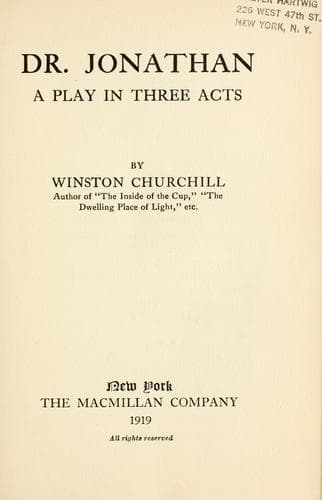
Mills and mill-work -- Management -- Drama; New England -- Drama; Veterans -- United States -- Drama; World War, 1914-1918 -- Drama
Und now I go away, and maybe my wife she die before I get to the
shipyard at Newcastle.
(He goes slowly out, upper right, and GEORGE does not attempt to
stay him. Enter ASHER, lower right.)
ASHER. I've just called up the Department in Washington and given them
a piece of my mind--told 'em they'd have to conscript labour. Damn these
unions, making all this trouble, and especially today, when you're going
off. I haven't had a chance to talk to you. Well, you know that I'm
proud of you, my boy. Your grandfather went off to the Civil War when he
was just about your age.
GEORGE. And he knew what he was going to fight for.
ASHER. What?
GEORGE. I thought I knew, this morning. Now I'm not so sure.
ASHER. You say that, when Germany intended to come over here and crush
us, when she got through with the Allies.
GEORGE. No, it's not so simple as that, dad, it's bigger than that.
ASHER. Who's been talking to you? Jonathan Pindar? I wish to God he'd
never come to Foxon Falls! I might have known what his opinions would
be, with his inheritance. (Reproachfully.) I didn't suppose you could be
so easily influenced by sentimentalism, George, I'd hoped you'd got over
that.
GEORGE. Are you sure it's sentimentalism, dad? Dr. Jonathan didn't say
much, but I'll admit he started me thinking. I've begun to realize a few
things--
ASHER. What things?
GEORGE (glancing at the clock on the mantel). I haven't got time to tell
you,--I'm afraid I couldn't make it clear, anyway,--it isn't clear in
my own mind yet. But,--go slow with this labour business, dad, there's
dynamite in it.
ASHER. Dynamite?
GEORGE. Human dynamite. They're full of it,--we're full of it, too, I
guess. They're not so different from you and me, though I'll admit that
many of them are ignorant, prejudiced and bitter. But this row isn't
just the result of restlessness and discontent,--that's the smoke, but
the fire's there, too. I've heard enough this morning to be convinced
that they're struggling for something fundamental, that has to do with
human progress,--the issue behind the war. It's obscured now, in the
smoke. Now if that's so you can't ignore it, dad, you can't suppress it,
the only thing to do is to sit down with them and try to understand it.
If they've got a case, if the union has come to stay, recognize it and
deal with it.
ASHER. You--you, my son, are not advising me to recognize the union! To
give our employees a voice in our private affairs!
GEORGE (courageously). But is the war our private affair, dad? Hasn't it
changed things already?
(ASHER makes a gesture of pain, of repudiation. GEORGE approaches
him appealingly.)
Dad, you know how much we've always been to each other, I'd hate to have
any misunderstanding between us,--especially today. I've always accepted
your judgment. But I'm over twenty one, I'm going to fight this war,
I've got to make up my own mind about it.
Public-domain text, read in full here on John Shaqi.
Reviews
Reviews
No reviews yet
Be the first to share your thoughts on this work.
Join the Discussion
Join the discussion
Sign in to leave a comment or review.
Sign InorCreate an account