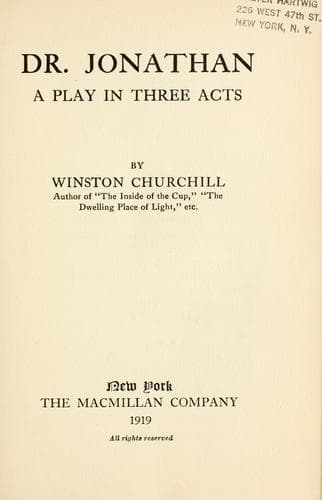
Mills and mill-work -- Management -- Drama; New England -- Drama; Veterans -- United States -- Drama; World War, 1914-1918 -- Drama
DR. JONATHAN. It happens to be. But I have had no chance to test
it--except on animals. I meant to have gone to a war hospital in New
York today. If it works, then we shall have to try the rest of the
experiment,--your half of it.
ASHER. What's that?
DR. JONATHAN. You probably noticed that George avoided you.
ASHER. It's more than I can bear. You know what we've been to each
other. If he should die--feeling that way--!
DR. JONATHAN. George hasn't lost his affection for you; if it were so,
we shouldn't have that symptom. I will tell you, briefly, my theory of
the case. But first let me say, in justice to Frye, that he was in no
position to know certain facts that give the clue to George's condition
the mental history.
ASHER. I don't understand.
DR. JONATHAN. The day he left home, for France, certain things happened
to him to arouse his sympathy with what we call working people, their
lives and aspirations. As you know, George has a very human side,--he
loves his fellow men. He'd never thought of these things before. He went
with them, naturally, to you, and I infer that you suppressed him!
ASHER. I told him I couldn't discuss certain aspects. His emotional
state troubled me,--he was going away, and I imagined he would get over
it.
DR. JONATHAN. He didn't get over it. It was an emotional crisis. He left
home with a conflict in his mind,--a conflict between his affection for
you and that which he had suddenly come to see was right. I mean, right
for today, for the year and hour in which we are living. This question
of the emancipation of labour began a hundred years ago, with the
introduction of machinery and the rise of modern industry, and in this
war it has come to a head. Well, as the time approached for George to
risk his life for his new beliefs, his mental conflict deepened. He
talked with other young men who believed they were fighting for the same
cause. And then--it must have been shortly before he was wounded--he
wrote you that appeal.
ASHER. The letter I read to you!
Public-domain text, read in full here on John Shaqi.
Reviews
Reviews
No reviews yet
Be the first to share your thoughts on this work.
Join the Discussion
Join the discussion
Sign in to leave a comment or review.
Sign InorCreate an account