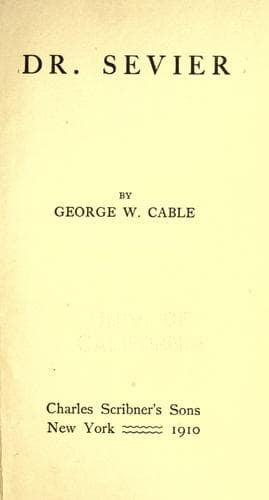
New Orleans (La.) -- Social life and customs -- 19th century -- Fiction; Physicians -- Fiction
"And who cares if it doesn't?" cried John, clasping her to his bosom.
"I do," she replied. "Yes, I do. I've no right to steal you from the
rest of the world, or from the place in it that you ought to fill.
John"--
"That's my name."
"Why can't I do something to help you?"
John lifted his head unnecessarily.
"No!"
"Well, then, let's think of something we can do, without just waiting
for the wind to blow us along,--I mean," she added appeasingly, "I mean
without waiting to be employed by others."
"Oh, yes; but that takes capital!"
"Yes, I know; but why don't you think up something,--some new enterprise
or something,--and get somebody with capital to go in with you?"
He shook his head.
"You're out of your depth. And that wouldn't make so much difference,
but you're out of mine. It isn't enough to think of something; you must
know how to do it. And what do I know how to do? Nothing! Nothing that's
worth doing!"
"I know one thing you could do."
"What's that?"
"You could be a professor in a college."
John smiled bitterly.
"Without antecedents?" he asked.
Their eyes met; hers dropped, and both voices were silent. Mary drew a
soft sigh. She thought their talk had been unprofitable. But it had not.
John laid hold of work from that day on in a better and wiser spirit.
CHAPTER XIII.
THE BOUGH BREAKS.
By some trivial chance, she hardly knew what, Mary found herself one day
conversing at her own door with the woman whom she and her husband had
once smiled at for walking the moonlit street with her hand in willing
and undisguised captivity. She was a large and strong, but extremely
neat, well-spoken, and good-looking Irish woman, who might have seemed
at ease but for a faintly betrayed ambition.
She praised with rather ornate English the good appearance and
convenient smallness of Mary's house; said her own was the same size.
That person with whom she sometimes passed "of a Sundeh"--yes, and
moonlight evenings--that was her husband. He was "ferst ingineeur" on a
steam-boat. There was a little, just discernible waggle in her head as
she stated things. It gave her decided character.
"Ah! engineer," said Mary.
"_Ferst_ ingineeur," repeated the woman; "you know there bees ferst
ingineeurs, an' secon' ingineeurs, an' therd ingineeurs. Yes." She
unconsciously fanned herself with a dust-pan that she had just bought
from a tin peddler.
She lived only some two or three hundred yards away, around the corner,
in a tidy little cottage snuggled in among larger houses in Coliseum
street. She had had children, but she had lost them; and Mary's
sympathy when she told her of them--the girl and two boys--won the
woman as much as the little lady's pretty manners had dazed her. It was
not long before she began to drop in upon Mary in the hour of twilight,
and sit through it without speaking often, or making herself especially
interesting in any way, but finding it pleasant, notwithstanding.
Public-domain text, read in full here on John Shaqi.
Reviews
Reviews
No reviews yet
Be the first to share your thoughts on this work.
Join the Discussion
Join the discussion
Sign in to leave a comment or review.
Sign InorCreate an account