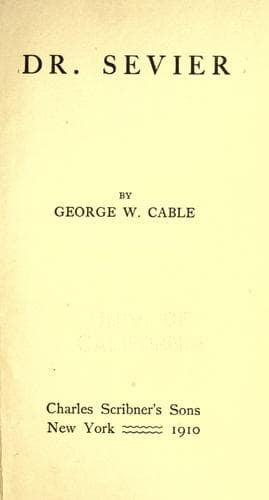
New Orleans (La.) -- Social life and customs -- 19th century -- Fiction; Physicians -- Fiction
The physician was silent. He turned the matter over once more in his
mind. The proposal was absurdly unbusiness-like. That his part in it
might look ungenerous was nothing; so his actions were right, he rather
liked them to bear a hideous aspect: that was his war-paint. There was
that in the stranger's attitude that agreed fairly with his own theories
of living. A fear of debt, for instance, if that was genuine it was
good; and, beyond and better than that, a fear of money. He began to be
more favorably impressed.
"Give it to me," he said, frowning; "mark you, this is your way,"--he
dropped the gold into his vest-pocket,--"it isn't mine."
The young man laughed with visible relief, and rubbed his knee with his
somewhat too delicate hand. The Doctor examined him again with a milder
glance.
"I suppose you think you've got the principles of life all right, don't
you?"
"Yes, I do," replied the other, taking his turn at folding arms.
"H-m-m! I dare say you do. What you lack is the practice." The Doctor
sealed his utterance with a nod.
The young man showed amusement; more, it may be, than he felt, and
presently pointed out his lodging-place.
"Here, on this side; Number 40;" and they alighted.
CHAPTER III.
HIS WIFE.
In former times the presence in New Orleans, during the cooler half of
the year, of large numbers of mercantile men from all parts of the
world, who did not accept the fever-plagued city as their permanent
residence, made much business for the renters of furnished apartments.
At the same time there was a class of persons whose residence was
permanent, and to whom this letting of rooms fell by an easy and natural
gravitation; and the most respectable and comfortable rented rooms of
which the city could boast were those _chambres garnies_ in Custom-house
and Bienville streets, kept by worthy free or freed mulatto or quadroon
women.
In 1856 the gala days of this half-caste people were quite over.
Difference was made between virtue and vice, and the famous quadroon
balls were shunned by those who aspired to respectability, whether their
whiteness was nature or only toilet powder. Generations of domestic
service under ladies of Gallic blood had brought many of them to a
supreme pitch of excellence as housekeepers. In many cases money had
been inherited; in other cases it had been saved up. That Latin feminine
ability to hold an awkward position with impregnable serenity, and, like
the yellow Mississippi, to give back no reflection from the overhanging
sky, emphasized this superior fitness. That bright, womanly business
ability that comes of the same blood added again to their excellence.
Not to be home itself, nothing could be more like it than were the
apartments let by Madame Cecile, or Madame Sophie, or Madame Athalie,
or Madame Polyxene, or whatever the name might be.
Public-domain text, read in full here on John Shaqi.
Reviews
Reviews
No reviews yet
Be the first to share your thoughts on this work.
Join the Discussion
Join the discussion
Sign in to leave a comment or review.
Sign InorCreate an account