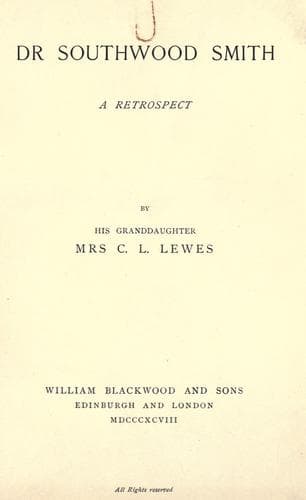
Dr. Southwood Smith: A RetrospectLewes, Gertrude Hill
History
Dr. Southwood Smith: A Retrospect
Lewes, Gertrude Hill
Physicians -- Great Britain -- Biography; Smith, Southwood, 1788-1861
The facts advanced to prove these principles have not, of course, the
wide range, the distinct statistical exactness, of those which the
further progress of sanitary science has now enabled people to bring
forward; but it is very interesting to see how all further advance has
been but a development of the principles brought forward in this
'Treatise on Fever,' just as it was itself but a development of those
brought forward five years before. Hardly any investigations had yet
been made, but the results which research would bring to light are here
foreshadowed. Even the direction which such research would take is
indicated, for we are told, at the end of the chapter which treats of
the "Causes of Fever," that--
"Further inquiries are necessary--such as, whether the vegetable and
animal poisons we have been considering be the _only_ true, exciting
cause of fever;[8] by what means its general diffusion is effected; on
what conditions its propagation depends; by what measures its extension
may be checked and its power diminished or destroyed; what circumstances
in the modes of life, in the habits of society, in the structure of
houses, in the condition of the public streets and common sewers, in the
state of the soil over large districts of the country as influenced by
the mode of agriculture, drainage, and so on, favour or check the origin
and propagation of this great curse of civilised, no less than of
uncivilised, man."
Not a mere article or book contained the result of such inquiries. They
occupied the greater part of his life, and that of many others. Their
outcome is the present state of sanitary knowledge.
If some people think there was nothing new in the view of epidemics
insisted on in this Treatise, they have only to see what was the common
opinion at that time amongst medical men. A few shared the writer's
opinions, but the majority of English physicians then certainly took
quite the opposite view. When Asiatic cholera first broke out in 1831,
it was of no avail that the physicians of Bengal had declared
unanimously that "the attempt to prevent the introduction of cholera by
a rigorous quarantine had always and utterly failed"; it was of no avail
that the articles on "Quarantine Laws" had, six years before, urged the
same truth; the London College of Physicians issued, notwithstanding, a
notification that, wherever cholera appeared, the sick should be
collected together in houses, which should be marked conspicuously
_Sick_; and that, even after the sufferers had been removed, and the
houses purified, _Caution_ should be marked on them. That the dead from
cholera should be buried in separate ground; that food to be delivered
at a house where any one was sick should be placed outside, and only
taken in when the person who brought it had gone away; and that no one
who had communicated with a cholera patient should, during twenty days
after, communicate with the healthy.
Public-domain text, read in full here on John Shaqi.
Reviews
Reviews
No reviews yet
Be the first to share your thoughts on this work.
Join the Discussion
Join the discussion
Sign in to leave a comment or review.
Sign InorCreate an account