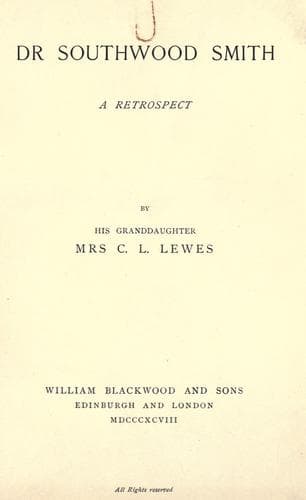
Dr. Southwood Smith: A RetrospectLewes, Gertrude Hill
History
Dr. Southwood Smith: A Retrospect
Lewes, Gertrude Hill
Physicians -- Great Britain -- Biography; Smith, Southwood, 1788-1861
One manager says: "I have known the children hide themselves in the wool
so that they could not go home when the work was over. I have seen six
or eight fetched out of the stove and beat out of the mill."
Another says: "After the children from eight to twelve years old had
worked eight or nine hours, they were nearly ready to faint: only kept
to their work by being spoken to, or by a little chastisement to make
them jump up. I was sometimes obliged to chastise them when they were
almost fainting, and it hurt my feelings; then they would spring up and
work pretty well for another hour; but the last two or three hours were
my hardest work, for they then got so exhausted."
And a third manager says: "I have seen them fall asleep, and they were
performing their work with their hands, while they were asleep, after
the 'billy' had stopped and their work was over."
Two great objections were made to any legislative limitation of the
number of hours of children's labour. One was, that it was impossible to
shorten their hours of work without also shortening those of the adults,
who could not go on without them; the other, that it was wrong to
restrict the liberty of the subject.
The first of these was, truly, a difficulty; but if the evil was so very
great, it appeared to my grandfather and those acting with him that some
change _must_ be made in the mode of working, rather than overtax the
children to this extent. Relays of children must be obtained, or
grown-up workers must be substituted as assistants.
With regard to the second objection--that it would be restricting the
liberty of private individuals if the law interfered--the Report shows
that children, at the age at which they suffered these injuries, were
not free agents, but were let out to hire by their parents, by whom
their wages were appropriated, and who were easily rendered callous to
their children's wrongs by a threat of dismissal, or a bribe of an
additional penny an hour of wage. If the law did not step in to protect
these unfortunate little ones from parents whose selfishness and
ignorance was allowing them to grow up diseased and benighted, where,
argues the Report, was their help to come from?
The question as to whether it is right in any instance for the
Government to intervene between parent and child, is now practically
settled by the many laws and enactments which regulate children's
education and hours of labour. But in those days the idea of any
restriction of a parent's right over his child excited much opposition.
It was regarded by many people as both impracticable and undesirable.
Public-domain text, read in full here on John Shaqi.
Reviews
Reviews
No reviews yet
Be the first to share your thoughts on this work.
Join the Discussion
Join the discussion
Sign in to leave a comment or review.
Sign InorCreate an account