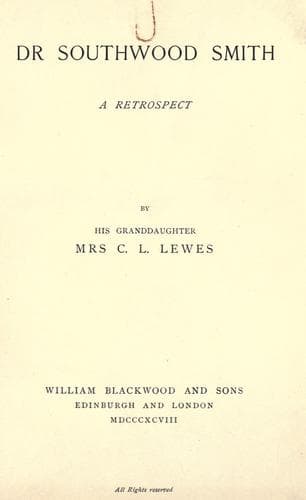
Dr. Southwood Smith: A RetrospectLewes, Gertrude Hill
History
Dr. Southwood Smith: A Retrospect
Lewes, Gertrude Hill
Physicians -- Great Britain -- Biography; Smith, Southwood, 1788-1861
The first step in the House of Commons was made in 1840, the year
following that which has just been spoken of as the one from which dates
the public beginning of the Sanitary movement, when Mr Slaney, M.P. (one
of the most earnest and energetic of the early labourers in the cause)
obtained a Committee of the House to "inquire into the sanitary state of
large towns in England." Mr Slaney wished not only to extend the
investigation, but to bring the striking results already obtained
directly before Parliament.
My grandfather was the first witness examined by the Committee, and
nearly the whole of his evidence was transferred to its minutes. Some of
his words were--
"_These miseries will continue till the Government will pass measures
which shall remove the sources of poison and disease from these places.
All this suffering might be averted. These poor people are victims that
are sacrificed. The effect is the same as if twenty or thirty thousand
of them were annually taken out of their wretched homes and put to
death; the only difference being that they are left in them to die._"
And how long was it before any measure to stop this could be carried
through Parliament? Dating from the time when he first examined Bethnal
Green and Whitechapel, _ten years_. Not long, perhaps, in reality,
considering the difficulties in the way, but very long to one who not
only believed, but most deeply felt and realised, the truth of such
words as those quoted above.
The history of events was this. In 1841 Lord Normanby brought in a
"Drainage of Buildings Bill." It was by no means a perfect one. My
grandfather wrote of it many years afterwards in the following words:--
"Subsequent discussion and inquiry greatly improved both the principles
and the details of sanitary legislation as compared with the proposals
in this bill. Still, honour to the House of Lords who carried it with a
cordial and noble spirit through their own House and sent it down to the
Commons!"
The session, however, came to an end before any discussion could there
be held on it.
Next year, 1842, was presented Mr Edwin Chadwick's Report on the
Sanitary Condition of the Labouring Population of Great Britain. He was
Secretary to the Poor Law Board, and this Report was, in fact, a Return
to the Bishop of London's motion of 1839. It confirmed and extended the
results of previous inquiries, and greatly helped to prepare the way for
legislation.
In 1843 Lord Normanby made a second attempt. It was again defeated. The
Administration of which he was a member was broken up before much
progress had been made with the new and improved bill which he had
introduced.
Public-domain text, read in full here on John Shaqi.
Reviews
Reviews
No reviews yet
Be the first to share your thoughts on this work.
Join the Discussion
Join the discussion
Sign in to leave a comment or review.
Sign InorCreate an account