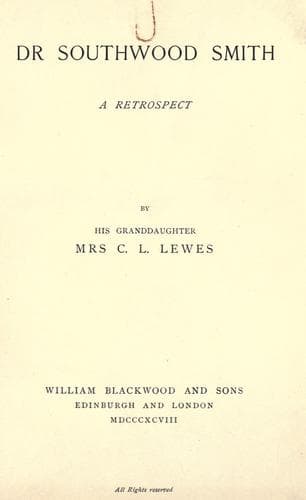
Dr. Southwood Smith: A RetrospectLewes, Gertrude Hill
History
Dr. Southwood Smith: A Retrospect
Lewes, Gertrude Hill
Physicians -- Great Britain -- Biography; Smith, Southwood, 1788-1861
of which has attained a higher longevity; yet it is certain that a
degree of longevity never yet witnessed has always been attainable,
because such longevity depends on conditions which are now
known--conditions entirely within human control.
I have said that there is involved in the mere length of life a
larger and higher boon than is apparent without reflection. First,
because length of life is in general a tolerably accurate measure of
the amount of health, without a good share of which life is
comparatively worthless. The instances are rare in which a person
attains to old age who has not enjoyed at least a moderate share of
daily health and vigour.
Secondly, because length of life is a perfectly accurate measure of
the amount of enjoyment. Long life is incompatible with a condition
of constant privation and wretchedness. It is one of the
beneficences of the constitution of our nature that when the balance
of happiness is against us, a limit is fixed to our misery by its
rapid termination in the insensibility of death. In the very brevity
of its existence, therefore, a human being indicates his own history
for evil; the shortness of his life is the sure and correct index of
the amount of his suffering, physical and mental: it is the result,
the sum-total, the aggregate expression, of the ills endured.
Thirdly, because length of life is the protraction of that portion
of life, and only of that portion of it, in which the human being is
capable of the greatest degree of usefulness. I have elsewhere shown
that every year by which the term of human life is extended is
really added to the period of mature age; the period when the organs
of the body have attained their full growth and put forth their full
strength; when the physical organisation has acquired its utmost
perfection; when the senses, the feelings, the emotions, the
passions, the affections are in the highest degree acute, intense,
and varied; when the intellectual faculties, completely unfolded and
developed, carry on their operations with the greatest vigour,
soundness, and continuity: in a word, when the individual is capable
of communicating, as well as of receiving, the largest amount of the
highest kind of happiness.
Public-domain text, read in full here on John Shaqi.
Reviews
Reviews
No reviews yet
Be the first to share your thoughts on this work.
Join the Discussion
Join the discussion
Sign in to leave a comment or review.
Sign InorCreate an account