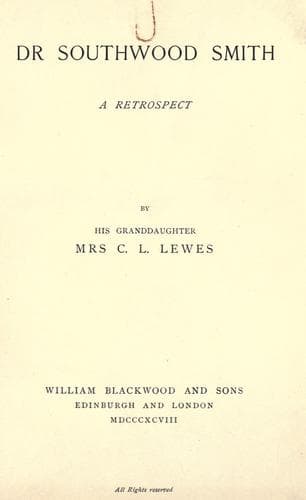
Dr. Southwood Smith: A RetrospectLewes, Gertrude Hill
History
Dr. Southwood Smith: A Retrospect
Lewes, Gertrude Hill
Physicians -- Great Britain -- Biography; Smith, Southwood, 1788-1861
"Let it not be said," he urges, "that the greater rate of mortality in
certain districts is owing to extreme poverty and the want of the
necessaries of life. The condition of the labourers of the west, the
lowness of their wages and the consequent scantiness of their food and
clothing, have been the subject of public animadversion. The mortality
of the south-western district, which includes Cornwall, Devon, Somerset,
Dorset, and Wilts, is only 1 in 52--not 2 per cent; while that of the
north-western, including Cheshire and Lancashire, is 1 in 37. With the
exception of the Cornish miners the condition of labourers throughout
the western counties is nearly the same, yet in Wiltshire, the county of
lowest wages, the deaths are 1 in 49, in Lancashire 1 in 36. The average
age at death in Wiltshire was thirty-five, in Lancashire twenty-two. The
Wiltshire labourer's average age was thirty-five, that of the Liverpool
operative fifteen. At Manchester, in 1836, the average consumption per
head of the population was 105 lb. of butcher's meat--about 2 lb. a-week
(exclusive of bacon, pork, fish, and poultry); the average age at death
was twenty years." He then brings forward evidence of the
preventibleness of most of the premature deaths.
Having proved the extent of the evil, Lord Morpeth proceeded to show how
it was proposed to meet it,--by what machinery of central board,
inspectors, &c; and, lastly, he entered into the money-saving that would
be effected were thorough sanitary measures carried out. He cites Dr
Playfair's estimates, which give the money loss, through unnecessary
sickness and death, at £11,000,000 for England and Wales, and at
£20,000,000 for the United Kingdom. This loss arises from many causes:
the expenses of direct attendance on the sick; the loss of what they
would have earned; the loss caused by the premature death of productive
contributors to the national wealth; and the expenses of premature
funerals.
But the measure which was framed to relieve this sum of misery, though
well and carefully prepared, was again to be thrown out!
It was weary work. The years were passing away, and nothing was being
done. My grandfather used to come home saddened by each new defeat. He
was sad at the delay, but he was not disheartened; he knew that the
thing would be done in time, and that the progress must be slow. He
could wait calmly in that belief and enjoy fully the beauty of the
sunset light during the summer evenings passed in our beautiful field,
overlooking the green slopes and large trees of Caen Wood, Highgate.
There our friends used to come to us, amongst others Professor Owen,
Robert Browning, William and Mary Howitt, and Hans Christian Andersen;
and we spent evenings that I can never forget, staying out constantly
till the moon rose or the stars came out. How he loved nature and all
happy things!
His faith did not err. The work of urging had not been in vain; the
movement could not be stopped; the time was ripe.
Public-domain text, read in full here on John Shaqi.
Reviews
Reviews
No reviews yet
Be the first to share your thoughts on this work.
Join the Discussion
Join the discussion
Sign in to leave a comment or review.
Sign InorCreate an account