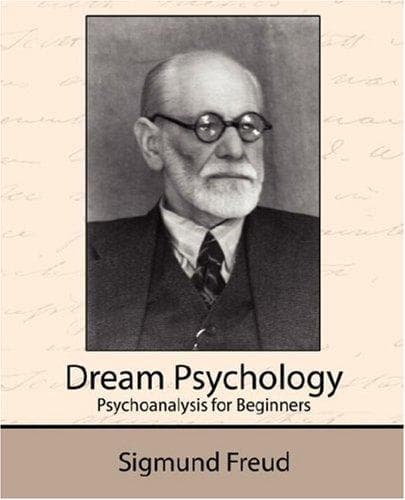
Dream Psychology: Psychoanalysis for BeginnersFreud, Sigmund
Science
Dream Psychology: Psychoanalysis for Beginners
Freud, Sigmund
Dreams; Psychoanalysis
It will hardly be worth while to take up the historical significance of
dreams as a special subject. Where, for instance, a chieftain has been
urged through a dream to engage in a bold undertaking the success of
which has had the effect of changing history, a new problem results only
so long as the dream, regarded as a strange power, is contrasted with
other more familiar psychic forces; the problem, however, disappears
when we regard the dream as a form of expression for feelings which are
burdened with resistance during the day and which can receive
reinforcements at night from deep emotional sources. But the great
respect shown by the ancients for the dream is based on a correct
psychological surmise. It is a homage paid to the unsubdued and
indestructible in the human mind, and to the demoniacal which furnishes
the dream-wish and which we find again in our unconscious.
Not inadvisedly do I use the expression "in our unconscious," for what
we so designate does not coincide with the unconscious of the
philosophers, nor with the unconscious of Lipps. In the latter uses it
is intended to designate only the opposite of conscious. That there are
also unconscious psychic processes beside the conscious ones is the
hotly contested and energetically defended issue. Lipps gives us the
more far-reaching theory that everything psychic exists as unconscious,
but that some of it may exist also as conscious. But it was not to prove
this theory that we have adduced the phenomena of the dream and of the
hysterical symptom formation; the observation of normal life alone
suffices to establish its correctness beyond any doubt. The new fact
that we have learned from the analysis of the psychopathological
formations, and indeed from their first member, viz. dreams, is that the
unconscious--hence the psychic--occurs as a function of two separate
systems and that it occurs as such even in normal psychic life.
Consequently there are two kinds of unconscious, which we do not as yet
find distinguished by the psychologists. Both are unconscious in the
psychological sense; but in our sense the first, which we call Unc., is
likewise incapable of consciousness, whereas the second we term "Forec."
because its emotions, after the observance of certain rules, can reach
consciousness, perhaps not before they have again undergone censorship,
but still regardless of the Unc. system. The fact that in order to
attain consciousness the emotions must traverse an unalterable series of
events or succession of instances, as is betrayed through their
alteration by the censor, has helped us to draw a comparison from
spatiality. We described the relations of the two systems to each other
and to consciousness by saying that the system Forec. is like a screen
between the system Unc. and consciousness. The system Forec. not only
bars access to consciousness, but also controls the entrance to
voluntary motility and is capable of sending out a sum of mobile energy,
Public-domain text, read in full here on John Shaqi.
Reviews
Reviews
No reviews yet
Be the first to share your thoughts on this work.
Elsewhere in the archive
Join the Discussion
Join the discussion
Sign in to leave a comment or review.
Sign InorCreate an account