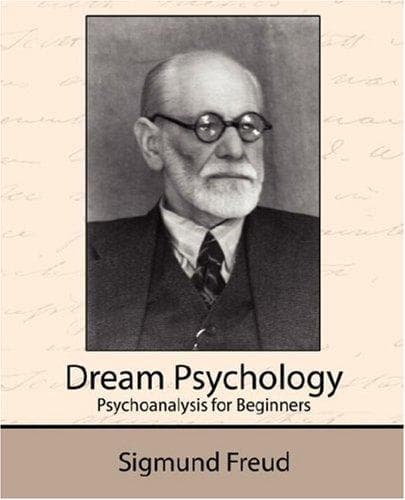
Dream Psychology: Psychoanalysis for BeginnersFreud, Sigmund
Science
Dream Psychology: Psychoanalysis for Beginners
Freud, Sigmund
Dreams; Psychoanalysis
A reaction from the over-estimation of the quality of consciousness
becomes the indispensable preliminary condition for any correct insight
into the behavior of the psychic. In the words of Lipps, the unconscious
must be accepted as the general basis of the psychic life. The
unconscious is the larger circle which includes within itself the
smaller circle of the conscious; everything conscious has its
preliminary step in the unconscious, whereas the unconscious may stop
with this step and still claim full value as a psychic activity.
Properly speaking, the unconscious is the real psychic; _its inner
nature is just as unknown to us as the reality of the external world,
and it is just as imperfectly reported to us through the data of
consciousness as is the external world through the indications of our
sensory organs_.
A series of dream problems which have intensely occupied older authors
will be laid aside when the old opposition between conscious life and
dream life is abandoned and the unconscious psychic assigned to its
proper place. Thus many of the activities whose performances in the
dream have excited our admiration are now no longer to be attributed to
the dream but to unconscious thinking, which is also active during the
day. If, according to Scherner, the dream seems to play with a symboling
representation of the body, we know that this is the work of certain
unconscious phantasies which have probably given in to sexual emotions,
and that these phantasies come to expression not only in dreams but also
in hysterical phobias and in other symptoms. If the dream continues and
settles activities of the day and even brings to light valuable
inspirations, we have only to subtract from it the dream disguise as a
feat of dream-work and a mark of assistance from obscure forces in the
depth of the mind (_cf._ the devil in Tartini's sonata dream). The
intellectual task as such must be attributed to the same psychic forces
which perform all such tasks during the day. We are probably far too
much inclined to over-estimate the conscious character even of
intellectual and artistic productions. From the communications of some
of the most highly productive persons, such as Goethe and Helmholtz, we
learn, indeed, that the most essential and original parts in their
creations came to them in the form of inspirations and reached their
perceptions almost finished. There is nothing strange about the
assistance of the conscious activity in other cases where there was a
concerted effort of all the psychic forces. But it is a much abused
privilege of the conscious activity that it is allowed to hide from us
all other activities wherever it participates.
Public-domain text, read in full here on John Shaqi.
Reviews
Reviews
No reviews yet
Be the first to share your thoughts on this work.
Elsewhere in the archive
Join the Discussion
Join the discussion
Sign in to leave a comment or review.
Sign InorCreate an account