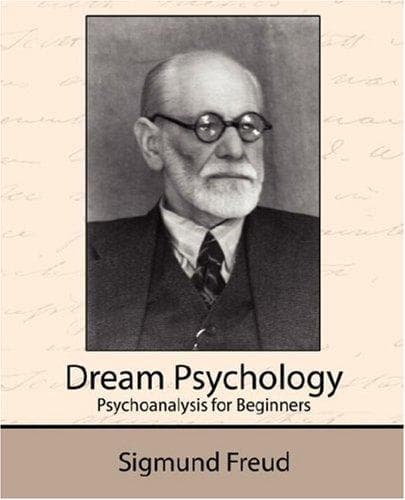
Dream Psychology: Psychoanalysis for Beginners — John Shaqi
Dream Psychology: Psychoanalysis for BeginnersFreud, Sigmund
Science
Dream Psychology: Psychoanalysis for Beginners
Freud, Sigmund
Dreams; Psychoanalysis
Through condensation of the dream certain constituent parts of its
content are explicable which are peculiar to the dream life alone, and
which are not found in the waking state. Such are the composite and
mixed persons, the extraordinary mixed figures, creations comparable
with the fantastic animal compositions of Orientals; a moment's thought
and these are reduced to unity, whilst the fancies of the dream are ever
formed anew in an inexhaustible profusion. Every one knows such images
in his own dreams; manifold are their origins. I can build up a person
by borrowing one feature from one person and one from another, or by
giving to the form of one the name of another in my dream. I can also
visualize one person, but place him in a position which has occurred to
another. There is a meaning in all these cases when different persons
are amalgamated into one substitute. Such cases denote an "and," a "just
like," a comparison of the original person from a certain point of view,
a comparison which can be also realized in the dream itself. As a rule,
however, the identity of the blended persons is only discoverable by
analysis, and is only indicated in the dream content by the formation of
the "combined" person.
The same diversity in their ways of formation and the same rules for its
solution hold good also for the innumerable medley of dream contents,
examples of which I need scarcely adduce. Their strangeness quite
disappears when we resolve not to place them on a level with the objects
of perception as known to us when awake, but to remember that they
represent the art of dream condensation by an exclusion of unnecessary
detail. Prominence is given to the common character of the combination.
Analysis must also generally supply the common features. The dream says
simply: _All these things have an "x" in common_. The decomposition of
these mixed images by analysis is often the quickest way to an
interpretation of the dream. Thus I once dreamt that I was sitting with
one of my former university tutors on a bench, which was undergoing a
rapid continuous movement amidst other benches. This was a combination
of lecture-room and moving staircase. I will not pursue the further
result of the thought. Another time I was sitting in a carriage, and on
my lap an object in shape like a top-hat, which, however, was made of
transparent glass. The scene at once brought to my mind the proverb: "He
who keeps his hat in his hand will travel safely through the land." By a
slight turn the _glass hat_ reminded me of _Auer's light_, and I knew
that I was about to invent something which was to make me as rich and
independent as his invention had made my countryman, Dr. Auer, of
Welsbach; then I should be able to travel instead of remaining in
Vienna. In the dream I was traveling with my invention, with the, it is
true, rather awkward glass top-hat. The dream work is peculiarly adept
at representing two contradictory conceptions by means of the same mixed
image.
Public-domain text, read in full here on John Shaqi.
Reviews
Reviews
No reviews yet
Be the first to share your thoughts on this work.
Join the Discussion
Join the discussion
Sign in to leave a comment or review.
Sign InorCreate an account