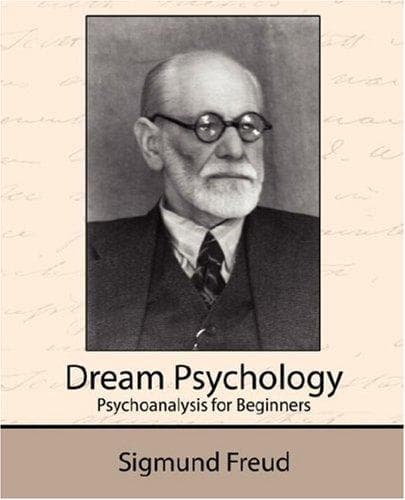
Dream Psychology: Psychoanalysis for BeginnersFreud, Sigmund
Science
Dream Psychology: Psychoanalysis for Beginners
Freud, Sigmund
Dreams; Psychoanalysis
This persistent wish to sleep on the part of the foreconscious in
general facilitates the formation of the dream. Let us refer to the
dream of the father who, by the gleam of light from the death chamber,
was brought to the conclusion that the body has been set on fire. We
have shown that one of the psychic forces decisive in causing the father
to form this conclusion, instead of being awakened by the gleam of
light, was the wish to prolong the life of the child seen in the dream
by one moment. Other wishes proceeding from the repression probably
escape us, because we are unable to analyze this dream. But as a second
motive power of the dream we may mention the father's desire to sleep,
for, like the life of the child, the sleep of the father is prolonged
for a moment by the dream. The underlying motive is: "Let the dream go
on, otherwise I must wake up." As in this dream so also in all other
dreams, the wish to sleep lends its support to the unconscious wish. We
reported dreams which were apparently dreams of convenience. But,
properly speaking, all dreams may claim this designation. The efficacy
of the wish to continue to sleep is the most easily recognized in the
waking dreams, which so transform the objective sensory stimulus as to
render it compatible with the continuance of sleep; they interweave this
stimulus with the dream in order to rob it of any claims it might make
as a warning to the outer world. But this wish to continue to sleep must
also participate in the formation of all other dreams which may disturb
the sleeping state from within only. "Now, then, sleep on; why, it's but
a dream"; this is in many cases the suggestion of the Forec. to
consciousness when the dream goes too far; and this also describes in a
general way the attitude of our dominating psychic activity toward
dreaming, though the thought remains tacit. I must draw the conclusion
that _throughout our entire sleeping state we are just as certain that
we are dreaming as we are certain that we are sleeping_. We are
compelled to disregard the objection urged against this conclusion that
our consciousness is never directed to a knowledge of the former, and
that it is directed to a knowledge of the latter only on special
occasions when the censor is unexpectedly surprised. Against this
objection we may say that there are persons who are entirely conscious
of their sleeping and dreaming, and who are apparently endowed with the
conscious faculty of guiding their dream life. Such a dreamer, when
dissatisfied with the course taken by the dream, breaks it off without
awakening, and begins it anew in order to continue it with a different
turn, like the popular author who, on request, gives a happier ending to
his play. Or, at another time, if placed by the dream in a sexually
exciting situation, he thinks in his sleep: "I do not care to continue
this dream and exhaust myself by a pollution; I prefer to defer it in
favor of a real situation."
Public-domain text, read in full here on John Shaqi.
Reviews
Reviews
No reviews yet
Be the first to share your thoughts on this work.
Elsewhere in the archive
Join the Discussion
Join the discussion
Sign in to leave a comment or review.
Sign InorCreate an account