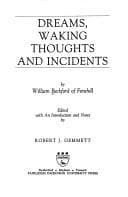
Dreams, Waking Thoughts, and IncidentsBeckford, William
General
Dreams, Waking Thoughts, and Incidents
Beckford, William
Beckford, William, 1760-1844
“Dear to the pensive eye of fond regret,
Is light still beaming from a sun that’s set.”
The residence of Petrarch at Arqua is said to have drawn thither from
Padua the society of its more enlightened citizens. This city, whilst
Petrarch lived in its neighbourhood, was engaged in rebellion against the
Venetians; and Francis de Carrara, the head of it, went often to Arqua,
to consult Petrarch; when he found himself obliged to sue to Venice for
peace. The poet was indeed deputed, upon this occasion, his ambassador
to the state; as being a person whose character and credit were most
likely to appease its wrath. His success in this embassy might, perhaps,
have been some recompense for an employment he accepted with much regret,
as it forced him from his beloved retirement. In a letter to one of his
friends, written about this period of his life, he says: “I pass the
greatest part of the year in the country, which I have always preferred
to cities: I read; I write; I think: thus, my life and my pleasures are
like those of youth. I take pains to hide myself; but I cannot escape
visits: it is an honour which displeases and wearies me. In my little
house on the Euganean hills, I hope to pass my few remaining days in
tranquillity, and to have always before my eyes my dead, or my absent,
friends.” I was musing on these circumstances as I walked along the
village, till a venerable old woman, seated at her door with her distaff
in her hand, observing me, soon guessed the cause of my excursion; and
offered to guide me to Petrarch’s house. The remainder of my way was
short, and well amused by my guide’s enthusiastic expressions of
veneration for the poet’s memory; which, she assured me, she felt but in
common with the other inhabitants of the village. When we came to the
door of the house, we met the peasant, its present possessor. The old
woman, recommending the stranger and his curiosity to her neighbour’s
good offices, departed. I entered immediately, and ran over every room,
which the peasant assured me, in confirmation of what I before learnt
from better authority, were preserved, as nearly as they could be, in the
state Petrarch had left them. The house and premises, having
unfortunately been transmitted from one enthusiast of his name to
another, no tenants have been admitted, but under the strictest
prohibition of making any change in the form of the apartments, or in the
memorial relics belonging to the place: and, to say the truth, everything
I saw in it, save a few articles of the peasant’s furniture in the
kitchen, has an authentic appearance. Three of the rooms below stairs
are particularly shown, and they have nothing in them but what once
belonged to the poet. In one, which I think they call his parlour, is a
very antique cupboard; where, it is supposed, he deposited some precious
part of his literary treasure. The ceiling is painted in a grotesque
manner. A niche in the wall contains the skeleton of his favourite cat,
Public-domain text, read in full here on John Shaqi.
Reviews
Reviews
No reviews yet
Be the first to share your thoughts on this work.
Elsewhere in the archive
Join the Discussion
Join the discussion
Sign in to leave a comment or review.
Sign InorCreate an account