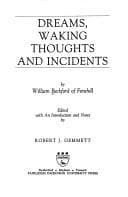
Dreams, Waking Thoughts, and IncidentsBeckford, William
General
Dreams, Waking Thoughts, and Incidents
Beckford, William
Beckford, William, 1760-1844
with a Latin epigram beneath, of Petrarch’s composition. It is good
enough to deserve being copied; but the lateness of the hour did not
allow me time. A little room, beyond this, is said to have been his
study: the walls of it, from top to bottom, are scribbled over with
sonnets, and poetical eulogies on Petrarch, ancient and modern: many of
which are subscribed by persons, of distinguished rank and talents,
Italians as well as strangers. Here, too, is the bard’s old chair, and
on it is displayed a great deal of heavy, ornamental carpentry; which
required no stretch of faith to be believed the manufacture of the
fourteenth century. You may be sure, I placed myself in it, with much
veneration, and the most resigned assent to Mrs. Dobson’s relation: that
Petrarch, sitting in this same chair, was found dead in his library, with
one arm leaning on a book. Who could sit in Petrarch’s chair, void of
some effect? I rose not from it without a train of pensive sentiments
and soft impressions; which I ever love to indulge. I was now led into a
larger room, behind that I first saw; where, it is likely enough, the
poet, according to the peasant’s information, received the visits of his
friends. Its walls were adorned with landscapes and pastoral scenes, in
such painting as Petrarch himself might, and is supposed to have
executed. Void of taste and elegance, either in the design or colouring,
they bear some characteristic marks of the age to which they are, with no
improbability, assigned; and, separate from the merit of exhibiting
repeatedly the portraits of Petrarch and Laura, are a valuable sketch of
the rude infancy of the art, where it rose with such hasty vigour to
perfection. Having seen all that was left unchanged in this consecrated
mansion, I passed through a room, said to have been the bard’s bed-room,
and stepped into the garden, situated on a green slope, descending
directly from the house. It is now rather an orchard than a garden; a
spot of small extent, and without much else to recommend it, but that it
once was the property of Petrarch. It is not pretended to have retained
the form in which he left it. An agreeably wild and melancholy kind of
view, which it commands over the Euganean hills, and which I beheld under
the calm glow of approaching sunset, must often, at the same moment, have
soothed the poet’s anxious feelings, and hushed his active imagination,
as it did my own, into a delicious repose. Having lingered here till the
sun was sunk beneath the horizon, I was led a little way farther in the
village, to see Petrarch’s fountain. Hippocrene itself could not have
been more esteemed by the poet, than this, his gift, by all the
inhabitants of Arqua. The spring is copious, clear, and of excellent
water; I need not say with what relish I drank of it. The last religious
act in my little pilgrimage was a visit to the church-yard; where I
strewed a few flowers, the fairest of the season, on the poet’s tomb; and
Public-domain text, read in full here on John Shaqi.
Reviews
Reviews
No reviews yet
Be the first to share your thoughts on this work.
Elsewhere in the archive
Join the Discussion
Join the discussion
Sign in to leave a comment or review.
Sign InorCreate an account