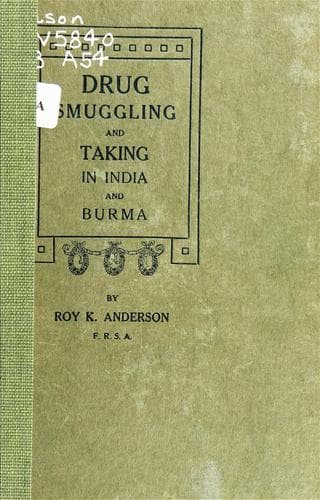
Drug Smuggling and Taking in India and BurmaAnderson, Roy K.
History
Drug Smuggling and Taking in India and Burma
Anderson, Roy K.
Drug addiction -- Burma; Drug addiction -- India; Drug traffic -- Burma; Drug traffic -- India
Nowhere is the need for sharp-witted informers so keenly felt as in
departments whose duty it is to prevent smuggling, and it may be taken
for granted that the greater the blackguard the fellow is, the more
useful he will be, and the more useful an informer is to the executive,
the greater danger he goes in of losing his life (because the smuggler
does not hesitate as to the means he employs in removing obstacles from
his path). The authorities have therefore to consider these things when
they come to pay the informer. The legislature also protects him by
providing that no officer shall be compelled in a law court to disclose
the name of his informer. That advantage is duly taken of this provision
there need be no doubt. The officer who gives up the name of his informer
has little further information to expect, as the informer very naturally
values his life, and will give no information to an indiscreet and
injudicious officer.
That the authorities are often imposed upon by informers is a matter of
course. There are lots of men in this world who would like to pay off
an old score against another, and an easy way to do this is to lodge
an information against him. A search of the premises occupied by the
suspect results, and although nothing may be found, the attention of the
neighbourhood is attracted, and for some time the search is a topic of
conversation, which is by no means pleasant for the man whose house is
searched. The disgrace attending such an occurrence is intensified if the
householder happens to be a man who is respected as upright and honest.
Severe punishment is provided by the law for givers of false information,
but such cases are happily not numerous.
To take action against an informer for giving false information usually
results in deterring genuine informers from giving genuine information;
for there are factors which operate against the success of the genuine
informer. For instance, the object searched for may be removed just
before the search is made, or even during the search, and a blank is
drawn. To prosecute the informer for giving false information in such
circumstances would be manifestly unjust. If he were prosecuted, other
informers would not run the risk of giving information and work would
come to a standstill. Where, then, is the line to run? This is a question
which confronts the executive with ever-increasing perplexity. It seems
to be better to disregard the stray cases of false informing, than to
jeopardise the entire preventive department’s being. A certain officer,
suspecting that a search had been made on false information, issued an
order, _ex cathedra_, that all informations should be verified before
search was made. As the only way in which information can be verified
is by making a search, it is not clear to what extent this order was
conceived in a spirit of bumptiousness, and how much of it in ignorance.
Public-domain text, read in full here on John Shaqi.
Reviews
Reviews
No reviews yet
Be the first to share your thoughts on this work.
Join the Discussion
Join the discussion
Sign in to leave a comment or review.
Sign InorCreate an account