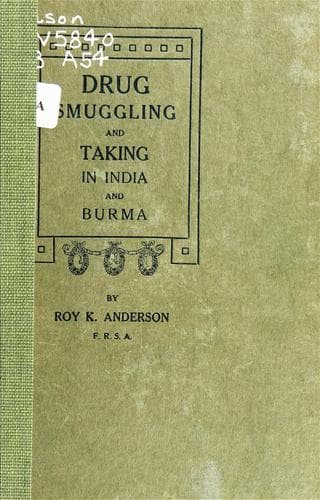
Drug Smuggling and Taking in India and Burma — John Shaqi
Drug Smuggling and Taking in India and BurmaAnderson, Roy K.
History
Drug Smuggling and Taking in India and Burma
Anderson, Roy K.
Drug addiction -- Burma; Drug addiction -- India; Drug traffic -- Burma; Drug traffic -- India
His offence against the revenue laws provides the smuggler with a
never-ending source of pure delight. Every fresh triumph in this
direction he looks upon as another feather in his already innumerably
be-feathered cap.
But there can be no question about the dreadful misery for which the
smuggler is directly responsible, and in succeeding chapters I shall
endeavour to give as realistic a picture as I can of the awful results of
this damnable traffic in drugs.
THE DRUG HABIT.
CHAPTER VII.
OPIUM.[1]
It may be taken for granted that most people are in some degree
acquainted with the use of opium, having had it at some time or other
administered to them as a medicine. Dover’s powder, so useful a remedy
for a cold, contains opium; Laudanum is a preparation of it which is
familiar to everybody; and there are scores of other remedies and
proprietary preparations which contain opium to a greater or less extent.
But useful as opium may be, it must be used with discretion, and must not
be allowed to change its character of a faithful servant for that of a
master. It can become an exacting and dominating master, and the habit
once formed is well nigh ineradicable.
For the information of those who have not seen the pure drug, I may
mention that opium is a dark brown, putty-like substance with an
agreeable, sweetish, odour. It is the dried resin obtained by incising
the unripe capsules of a certain variety of poppy, and is prepared in
large, well-equipped factories, from which it is issued in cakes and
balls weighing eighty tolas.[2]
The opium industry is a Government monopoly. The poppy crops are grown
under Government supervision, and the factories where it is prepared
belong to Government and are staffed by Government servants. The prepared
product is sold from Government opium shops from which consumers who are
so privileged can get their requirements at a certain fixed price.[3] But
as is the case with all monopolized commodities, opium may assume a money
value far in excess of its intrinsic worth and be sold for its weight in
silver. In fixing the price of opium, Government is confronted with a
choice between two courses: either to sell opium cheap, and so extinguish
the smuggler; or to prohibit it entirely and thereby convert India into
a happy hunting ground for the avaricious and rapacious fortune hunter.
It takes a middle course, therefore, and sells opium at such a rate that
facilities for obtaining it are reasonable, without, on the one hand,
rendering it cheap and easily obtainable, or, on the other, making it
prohibitive. The policy pursued is one of eventual suppression; the
discouragement of recruits to the opium habit being the means employed
as best adapted to bring about its realization.
Public-domain text, read in full here on John Shaqi.
Reviews
Reviews
No reviews yet
Be the first to share your thoughts on this work.
Join the Discussion
Join the discussion
Sign in to leave a comment or review.
Sign InorCreate an account