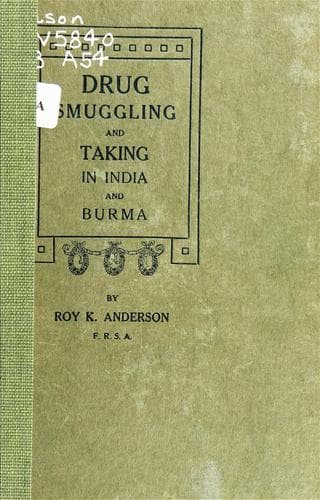
Drug Smuggling and Taking in India and BurmaAnderson, Roy K.
History
Drug Smuggling and Taking in India and Burma
Anderson, Roy K.
Drug addiction -- Burma; Drug addiction -- India; Drug traffic -- Burma; Drug traffic -- India
I once met a missionary, and in the course of conversation, we happened
upon the opium evil. He was eloquent, his views on the subject were
decided. In fact he was so decided in his views that I found it
impossible to convince him that what he described as the effects of opium
were really those symptomatic of an overdose of _bhang_. And yet, I have
little doubt that this person must have written home lurid accounts of
the opium evil, and the ruin and havoc it was causing. What reformers
ought to do is to cease memorializing Government to totally prohibit the
traffic, and try to help them more by taking an active part in checking
immoderation. Moderate indulgence in opium is less harmful in every way
than the habit of passing public resolutions and submitting memorials.
By the foregoing, I do not wish it to be surmised that I hold a brief
for the opium habit, or that I consider it a desirable thing. To be
a slave in any degree to anything is bad; the tobacco habit is bad;
the over-eating habit is bad. But opium comes in for too much of the
attention of religious propagandists, and the Government is taxed with
the charge of reaping revenue at the expense of the bodies and souls
of the people. This is a view it is the duty of anyone who knows the
subject intimately to correct. The Royal Commission on Opium in India,
which sat under the chairmanship of Lord Brassey, some thirty years ago,
collected a mass of evidence for and against opium which is unrivalled
in its extent and value. The conclusion come to by a majority of the
Commissioners was that opium in moderation did no great harm; and to
ensure moderation, they recommended a policy of close control. In
deference to popular opinion, and the religious scruples of the bulk of
Indians, they thought it desirable that the opium habit should eventually
be suppressed, and trusted that close control would, by attrition, bring
about this result.
CHAPTER X.
MORPHIA.
Morphia, which is the active principle of opium, is interesting in its
being the first “alkaloid” to be discovered. Its basic nature was first
noticed by Serturner in 1816.
As a medicine, principally as an anodyne, morphia is to pharmacy what
chloroform is to surgery, and, as a “boon and blessing” to man in that
character, it is second to none. But like all good things in this world,
it has become the object of the grossest abuse at the hand of man; and
its devotees, in an euphonic sense, number hundreds of thousands.
Public-domain text, read in full here on John Shaqi.
Reviews
Reviews
No reviews yet
Be the first to share your thoughts on this work.
Join the Discussion
Join the discussion
Sign in to leave a comment or review.
Sign InorCreate an account