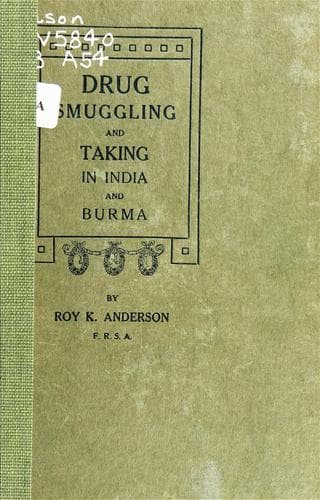
Drug Smuggling and Taking in India and BurmaAnderson, Roy K.
History
Drug Smuggling and Taking in India and Burma
Anderson, Roy K.
Drug addiction -- Burma; Drug addiction -- India; Drug traffic -- Burma; Drug traffic -- India
It is in the nature of things that articles which have come to be looked
upon as necessaries of life, such as tea, tobacco, wine and spirits,
should be taxed moderately; and indeed, were any attempt made to
render them less easily obtained by raising the taxes on them, unless
this course was vital in the interests of the country, there would be
just reasons for profound popular dissatisfaction and disgust; but in
the matter of noxious intoxicating drugs the case is reversed, and
authoritative opinion inclines to the highest taxation, or even to total
prohibition. Opium is taxed to a point little short of prohibition;
morphia and cocaine are entirely prohibited to the public except for
medical purposes; and hemp drugs are highly taxed in India, and totally
prohibited in Burma. Those who quarrel with this state of things are such
as have become habituated to these drugs, and of this class there is,
unhappily, a large number, so large a number indeed, that their demand
for a regular and sufficient supply constitutes a rich market, a market
which is supplied by the smuggler who reaps abundant profits.
As in the case of other articles of commerce—and smuggling is as much
a branch of commerce as the traffic in rice or jute—the scarcity or
abundance of supply of drugs is what regulates their price in the illicit
market. Normally, opium is sold from Government Opium Shops at from
Rs. 100 to Rs. 123 a seer. Illicitly, it costs from Rs. 200 to Rs. 300
a seer, and when scarce, from Rs. 350 to Rs. 400 a seer. Illicitly,
cocaine and morphia are sold at from five to six times the chemist’s
price. It is true that the smuggler has to pay and maintain a large staff
of assistants, and has to bear other heavy expenses, but the net profit
he eventually gets is a very substantial one.
It is impossible to entirely prevent smuggling: the interested motives of
mankind will always prompt them to attempt it. All that the Government
can do is to compromise with an offence which, whatever the criminal law
on the subject may say, appears to the mind of the smuggler, and of the
drug habitué he supplies, as not at all equalling in turpitude those acts
which are clear breaches of the elementary principles of ethics.
Public-domain text, read in full here on John Shaqi.
Reviews
Reviews
No reviews yet
Be the first to share your thoughts on this work.
Join the Discussion
Join the discussion
Sign in to leave a comment or review.
Sign InorCreate an account