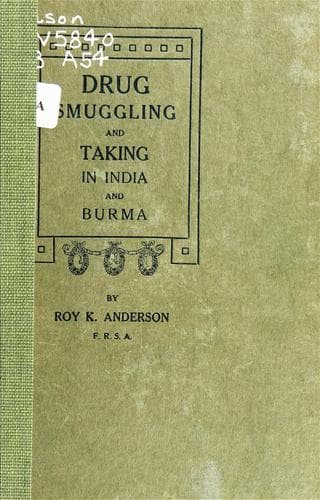
Drug Smuggling and Taking in India and Burma — John Shaqi
Drug Smuggling and Taking in India and BurmaAnderson, Roy K.
History
Drug Smuggling and Taking in India and Burma
Anderson, Roy K.
Drug addiction -- Burma; Drug addiction -- India; Drug traffic -- Burma; Drug traffic -- India
The Germans discovered a method by which cocaine can be manufactured
synthetically; and bogey hunters will discover a deep plot to undermine
the physique and morals of Indians when they are told that the synthetic
manufacture of cocaine is, to all intents and purposes, a state-aided
industry. It is classed as an industry, and as such receives the spirit
used in the preparation of the synthetic drug, duty-free. Ninety per
cent. of the cocaine imported into this country before the war came from
Germany.
It would probably surprise the Darmstadt firm, which purveyed almost all
the cocaine that came to Burma, if they knew that their drachm-phials,
neatly capsuled, and labelled “Cocaine Hydrochloride,” ought really
sometimes to have been labelled “Antefebrin,” for that indeed is what
a great number that were seized by the authorities contained. In
appearance, cocaine and antefebrin are hard to distinguish from one
another; and for a long time the results of analyses led the authorities
to suppose that the manufacturers were defrauding their eastern
constituents; but the discovery of a complete plant consisting of phials,
labels, capsules, and a large quantity of antefebrin, eventually cleared
the name of the doubtless reputable manufacturers, and fastened the guilt
upon local swindling smugglers.
CHAPTER XII.
HEMP DRUGS.
Like the poppy which is cultivated for opium, the hemp plant, _cannabis
sativa_, is grown for _ganja_, _bhang_, and _churrus_, all highly
intoxicating drugs; and for its bast fibre which makes such excellent
rope.
The history of the plant is interesting, but no more than a very brief
allusion to it is necessary here. The first mention of hemp occurs in
Chinese literature, about the twenty-eighth century, B.C., when the
hemp-seed is mentioned as one of the five or nine kinds of grain. It
is mentioned merely as a “sacred grass” in the _Athavaveda_ about 1400
B.C. But the narcotic properties of the plant, with which we are chiefly
concerned, do not seem to have been known until the beginning of the
fourteenth century A.D. In a Hindu play written about the sixteenth
century A.D., Siva brings down the _bhang_ plant from the Himalaya, and
gives it to the worshippers of himself. Of more recent evidence, we have
the statement of the Emperor Baber, who tells in his _Memoirs_ (1519
A.D.) of the number of times he had taken _Maajun_. John Lindsay, in his
_Journal of Captivity in Mysore_ (1781), relates how his soldiers were
made to eat _Majum_; and lastly, De Quincey, in his _Confessions of an
English Opium-Eater_, speaks of _Madjoon_, which he inaccurately states
is a Turkish name for opium.
Public-domain text, read in full here on John Shaqi.
Reviews
Reviews
No reviews yet
Be the first to share your thoughts on this work.
Join the Discussion
Join the discussion
Sign in to leave a comment or review.
Sign InorCreate an account