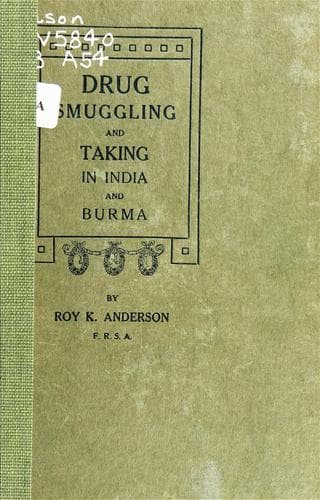
Drug Smuggling and Taking in India and BurmaAnderson, Roy K.
History
Drug Smuggling and Taking in India and Burma
Anderson, Roy K.
Drug addiction -- Burma; Drug addiction -- India; Drug traffic -- Burma; Drug traffic -- India
Three men, one under the effects of alcohol, one under the effects of
opium, and the last under the effects of hemp, arrived one night at the
closed gates of a city. “Let us break down the gates,” said the alcohol
drinker in a fury of rage, “I can do it with my sword!” “Nay,” said the
opium eater, “We can rest here outside in comfort till the morning, when
the gates will be opened, and we may enter.” “Why all this foolish talk?”
whined the one under the effects of hemp. “Let us creep in through the
key-hole. We can make ourselves small enough!”
APPENDIX.
AN HISTORICAL NOTE ON OPIUM IN INDIA AND BURMA.
It is doubtful whether there is a more valuable drug in the Materia
Medica than opium. Fundamentally, it is the dried juice of the _Papaver
Somniferum_ or white poppy, and although all varieties of poppy are
capable of producing opium, the best comes from the white, and it is this
variety that is systematically cultivated for the world’s supply of opium.
Opium has been the cause of at least one war, namely, the war between
England and China, and a perusal of the accounts of piracy in the eastern
seas during the sixteenth century affords numerous instances of pitched
battles between traders and pirates whose one object seems to have been
to get possession of valuable cargoes of opium.
The cultivation of the poppy, as a garden flower at any rate, was
certainly practised as far back as eight hundred years before Christ.
Homer, who lived between 800 B.C. and 700 B.C.[6] mentions it in his
Iliad.[7] Cornelius Nepos also mentions the poppy in Italy; when Tarquin
indicated to the envoy sent to him by his son Sextus Tarquinius, what he
wanted done to the chief inhabitants of Etruria, by striking down all the
tallest poppies in his garden.[8]
Hippocrates, who lived in the fifth century before Christ, and who is
famous as the founder of Greek medical literature, is the first to
mention poppy juice, and the virtues of the poppy were undoubtedly known
to him; but the physical effects of opium were not definitely mentioned
until the first century before Christ, when Vergil, who lived from 70
B.C. to 19 B.C., writes of the “Poppy pervaded with Lethean sleep,”[9]
and the “Sleep-giving poppy.”[10] It may be mentioned in passing, that in
Greek mythology Lethe is a river that flows through the regions of the
dead, the waters of which, if drunk by anyone, cause oblivion in regard
to their past existence.
In the first century after Christ, opium was known as a medicine.
Opium is mentioned by this name by Pliny[11] and by Dioscorides[12]
both of whom lived in this century and its soporific effect was well
known. The poppy was cultivated for opium on the eastern shores of the
Mediterranean, and as the bulk of the trade between Europe and the Indies
passed through these countries, it is certain that this drug, whose value
was known, must have formed a part of the trade, though not, perhaps, to
such a great extent as to attract attention.
Public-domain text, read in full here on John Shaqi.
Reviews
Reviews
No reviews yet
Be the first to share your thoughts on this work.
Join the Discussion
Join the discussion
Sign in to leave a comment or review.
Sign InorCreate an account