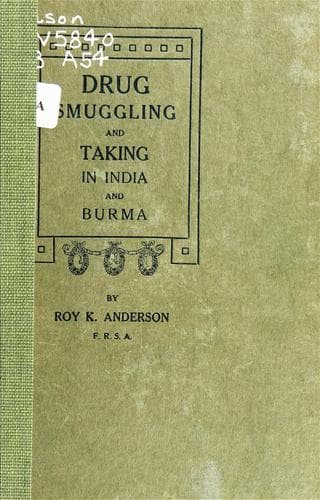
Drug Smuggling and Taking in India and BurmaAnderson, Roy K.
History
Drug Smuggling and Taking in India and Burma
Anderson, Roy K.
Drug addiction -- Burma; Drug addiction -- India; Drug traffic -- Burma; Drug traffic -- India
So far I have dealt exclusively with the man who smuggles in a large
and extended way. He might be likened to the big importer of ordinary
business. But, as in ordinary business, there are the retailers: those
who take the goods to the consumer. These men operate up-country, in the
sense that they work in the interior of the country. They may be agents
of the big men, or they may be merely his customers; but except that
their activities are confined, sometimes within the limits of a single
district, they are otherwise similar to the big men who live in the
cities. More often than not these men take an active and personal part in
disseminating drugs, and consequently coming frequently into contact with
the authorities, are more often brought to book for their misdemeanours.
But they do not have much at stake, and rarely risk more than they can
afford to lose if plans go wrong. Of course, there are these men in big
cities also; as a matter of fact there are a host of them in every big
city. To the square mile, there are many more consumers in a city than in
the interior, and as the big smuggler cannot be troubled with retailing
minute quantities of drugs, there is plenty to do for the lesser lights.
Why is it that these importers are never brought to book, is a question
that might reasonably be asked. The answer is simple. It is because they
never by chance handle the goods; they never allow it into their houses.
That a certain man is a smuggler is well known to the authorities. In
fact, the suspect will cheerfully admit it; he will even go as far as
telling them how it was that they failed to seize his last consignment
of contraband, and defy them to seize the next one he expects to import!
But he is perfectly acquainted with the law, and he knows that he cannot
be touched unless the contraband is found in his actual possession,
or, under such circumstances, within his house or its precincts, that
possession of it cannot be ascribed to anyone but himself. The law
prescribes a punishment for any person who, according to general repute,
earns his living, wholly or in part, by opium or morphia trafficking. The
smuggler evades the first part of this provision by keeping a mercantile
business going; and relies upon his personality, and the dread he
inspires in those who might otherwise seek to interfere with him, for
avoiding the second. The instinctive reluctance of respectable people to
make themselves party to judicial proceedings, and a very understandable
fear of extremely unpleasant consequences to themselves, deters them
from coming forward to give evidence against the smuggler, and this is
a great handicap to this very excellent piece of legislation. All that
the executive can hope to do is to seize as much of his contraband as
possible, and so, gradually, deprive him of the means to carry on his
trade.
Public-domain text, read in full here on John Shaqi.
Reviews
Reviews
No reviews yet
Be the first to share your thoughts on this work.
Join the Discussion
Join the discussion
Sign in to leave a comment or review.
Sign InorCreate an account