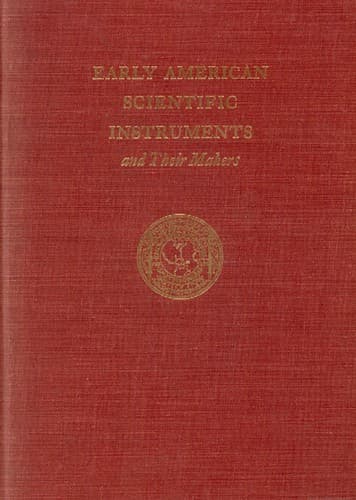
Early American Scientific Instruments and Their Makers — John Shaqi
Early American Scientific Instruments and Their MakersBedini, Silvio A.
History
Early American Scientific Instruments and Their Makers
Bedini, Silvio A.
Scientific apparatus and instruments
It can be surmised, therefore, that surveying instruments, as well as
instruments for other purposes, were produced in both brass and wood
simultaneously by many of the New England makers in order to provide
suitable instruments in a flexible price range to meet the demands of
the trade. Whereas today modern manufacturing methods make it possible
to produce instruments in a wide variety, both in quality and price, to
suit the needs and capabilities of every prospective purchaser, the
production facilities of the 18th century were much more limited. The
constant factor of skilled hand labor was costly. Metal was expensive.
As evidenced in the records of Daniel Burnap, for instance, it was
possible to produce surveying compasses in brass in two grades,
presumably one more elaborate than the other. Yet Burnap's prices ranged
between six pounds and four pounds for the metal instruments, making
them still well out of reach of many of the would-be surveyors.
Accordingly, Burnap--and presumably numerous other instrument makers of
the period--produced from wood an economy model that sold for not more
than two pounds, thus placing the item within the reach of the
nonprofessional surveyor.
This theory is supported amply by the discovery that several of the
instrument makers who worked in brass also made instruments of wood
during the same periods. In addition to the evidence in the records of
Daniel Burnap, there are the surviving surveying instruments in brass
and wood made by Samuel Thaxter, Thomas Greenough, and John Dupee,
leaving little if any doubt that the reason for producing surveying
compasses and similar items of wood during the 18th century was to
satisfy the need for reasonably accurate yet inexpensive instruments.
Surviving Instruments
The fact that the surviving examples of the wooden instruments were
produced only in New England seems to indicate merely that the New
England instrument makers were more familiar with the use of wood as a
material, and had greater facility in working with it.
Undoubtedly other instruments produced by the 18th-century American
makers have survived in addition to those already found. Quite likely
examples of these wooden instruments still remain hidden in unexplored
attics and other repositories. Yet, if the few thus far discovered is
any criterion, the number ultimately recoverable will probably be but a
fraction of the great number produced by the 18th-century makers during
the half century or more in which they worked. Even allowing for those
probably destroyed in the natural course of events, one cannot help but
wonder what has happened to the remainder.
Public-domain text, read in full here on John Shaqi.
Reviews
Reviews
No reviews yet
Be the first to share your thoughts on this work.
Join the Discussion
Join the discussion
Sign in to leave a comment or review.
Sign InorCreate an account