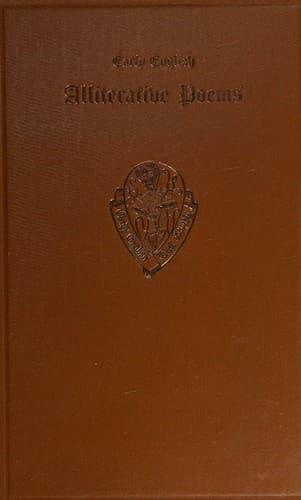
Early English Alliterative Poems: in the West-Midland Dialect of the Fourteenth Century
Religion
Early English Alliterative Poems: in the West-Midland Dialect of the Fourteenth Century
English poetry -- Middle English, 1100-1500
& carfully is out-kast to contré vnknawen,
Fer i{n}-to a fyr fryth þere frekes neu{er} comen. 1680
[Sidenote: He believes himself to be a bull or an ox.]
His hert heldet vnhole, he hoped non oþ{er}
Bot a best þat he be, a bol oþ{er} an oxe.
[Sidenote: Goes “on all fours,” like a cow, for seven summers.]
He fares forth on alle faure, fogge watȝ his mete,
& ete ay as a horce when erbes were fallen, 1684
Þus he cou{n}tes hy{m} a kow, þat watȝ a ky{n}g ryche,
Quyle seuen syþeȝ were ou{er}-seyed som{er}es I trawe.
[Sidenote: His thighs grew thick.]
By þat, mony þik thyȝe þryȝt vmbe his lyre,
Þat alle watȝ dubbed & dyȝt i{n} þe dew of heuen; 1688
[Sidenote: His hair became matted and thick, from the shoulders
to the toes.]
Faxe fylt{er}ed, & felt flosed hy{m} vmbe,
Þat schad fro his schulderes to his schyre wykes,
& twenty-folde twyna{n}de hit to his tos raȝt
Þer mony clyuy as clyde hit clyȝt to-geder. 1692
[Sidenote: His beard touched the earth.]
His berde I-brad alle his brest to þe bare vrþe,
[Sidenote: [Fol. 80b.]]
[Sidenote: His brows were like briars.]
His browes bresed as breres aboute his brode chekes;
[Sidenote: His eyes were hollow, and grey as the kite’s.]
Holȝe were his yȝen & vnder campe hores,
& al watȝ gray as þe glede, w{i}t{h} ful gry{m}me clawres 1696
Þat were croked & kene as þe kyte paune;[86]
[Sidenote: Eagle-hued he was.]
Erne-hwed he watȝ & al ou{er}-brawden,
Til he wyst ful wel who wroȝt alle myȝtes,
& cowþe vche kyndam tokerue & keu{er} when hy{m} lyked; 1700
[Sidenote: At last he recovered his “wit,” and believed in God.]
Þe{n}ne he wayned hy{m} his wyt þat hade wo soffered,
Þat he com to knawlach & ke{n}ned hy{m} seluen,
Þe{n}ne he laued[87] þat lorde & leued i{n} trawþe,
Hit watȝ non oþ{er} þen he þat hade al i{n} honde. 1704
[Sidenote: Then soon was he restored to his seat.]
Þe{n}ne sone watȝ he sende agayn, his sete restored;
His barou{n}es boȝed hy{m} to, blyþe of his come,
Haȝerly i{n} his aune hwe his heued watȝ cou{er}ed,
& so ȝeply watȝ ȝarked & ȝolden his state. 1708
[Sidenote: But thou, Belshazzar, hast disregarded these signs,
and hast blasphemed the Lord, defiled his vessels, filling them
with wine for thy wenches, and praising thy lifeless gods.]
Bot þ{o}u baltaȝar his barne & his bolde ayre,
Seȝ þese sy{n}gnes w{i}t{h} syȝt & set hem at lyttel,
Bot ay hatȝ hofen þy hert agaynes þe hyȝe dryȝt[y]n,
W{i}t{h} bobau{n}ce & w{i}t{h} blasfamye bost at hy{m} kest, 1712
& now his vessayles avyled i{n} vanyté vnclene,
Þat i{n} his hows hy{m} to hono{ur} were heue{n}ed of fyrst;
Bifore þe barou{n}ȝ hatȝ hom broȝt, & byrled þ{er}i{n}ne
Wale wyne to þy wenches i{n} waryed stou{n}des; 1716
Public-domain text, read in full here on John Shaqi.
Reviews
Reviews
No reviews yet
Be the first to share your thoughts on this work.
Elsewhere in the archive
Join the Discussion
Join the discussion
Sign in to leave a comment or review.
Sign InorCreate an account