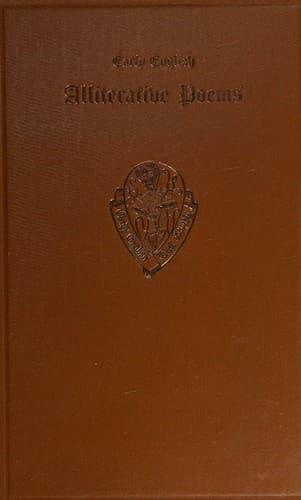
Early English Alliterative Poems: in the West-Midland Dialect of the Fourteenth Century
Religion
Early English Alliterative Poems: in the West-Midland Dialect of the Fourteenth Century
English poetry -- Middle English, 1100-1500
[Sidenote: Jonah is now in no dread.]
Bot he dredes no dynt þat dotes for elde,
For he watȝ fer i{n} þe flod fou{n}dande to tarce;
[Sidenote: He is, however, soon overtaken.]
Bot, I trow, ful tyd, ou{er}-tan þat he were,
So þat schomely to schort he schote of his ame. 128
[Sidenote: The wielder of all things has devices at will.]
For þe welder of wyt, þat wot alle þy{n}ges,
Þat ay wakes & waytes, at wylle hatȝ he slyȝtes;
He calde on þat ilk crafte he carf w{i}t{h} his hondes,
Þay wakened wel þe wroþeloker, for wroþely he cleped: 132
[Headnote: HE IS OVERTAKEN BY A TEMPEST.]
[Sidenote: He commands Eurus and Aquilo to blow.]
“Ewr{us} & aq{u}ilou{n}, þat on est sittes,
Blowes boþe at my bode vpon blo watt{er}es.”
[Sidenote: The winds blow obedient to His word.]
Þe{n}ne watȝ no tom þer bytwene his tale & her dede,
So bayn wer þay boþe two, his bone for to wyrk. 136
[Sidenote: Out of the north-east the noise begins.]
An-on out of þe norþ est þe noys bigynes,
When boþe breþes con blowe vpon blo watteres;
[Sidenote: [Fol. 85a.]]
Roȝ rakkes þer ros w{i}t{h} rudny{n}g an-vnder,
[Sidenote: Storms arose, winds wrestled together, the waves
rolled high, and never rested.]
Þe see souȝed ful sore, gret selly to here; 140
Þe wyndes on þe wo{n}ne wat{er} so wrastel to-geder,
Þat þe wawes ful wode walt{er}ed so hiȝe,
& efte busched to þe abyme þat breed fysches;
Durst nowhere for roȝ arest at þe bothem. 144
When þe breth & þe brok & þe bote metten,
[Sidenote: Then was Jonah joyless.]
Hit watȝ a ioyles gyn þat Ionas watȝ i{n}ne,
[Sidenote: The boat reeled around.]
For hit reled on rou{n}[d] vpon þe roȝe yþes.
[Sidenote: The gear became out of order.]
Þe bur ber to hit baft þat braste alle her gere, 148
Þen hurled on a hepe þe helme & þe sterne,
[Sidenote: Ropes and mast were broken.]
Furst to murte mony rop & þe mast aft{er}.
Þe sayl sweyed on þe see, þe{n}ne suppe bihoued
[Sidenote: A loud cry is raised, Many a lad labours to lighten
the ship.]
Þe coge of þe colde[6] wat{er}, & þe{n}ne þe cry ryses; 152
Ȝet coruen þay þe cordes & kest al þ{er}-oute.
Mony ladde þer forth-lep to laue & to kest,
Scopen out þe scaþel wat{er}, þat fayn scape wolde;
For be mo{n}nes lode[7] neu{er} so luþ{er}, þe lyf is ay swete. 156
[Sidenote: They throw overboard their bags and feather beds.]
Þer watȝ busy ou{er}-borde bal{e} to kest
Her bagges, & her feþ{er} beddes, & her bryȝt wedes,
Her kysttes, & her coferes, her caraldes alle,
& al to lyȝten þat lome, ȝif leþe wolde schape; 160
[Sidenote: But still the wind rages, and the waves become wilder.]
Bot eu{er} watȝ ilyche loud þe lot of þe wy{n}des,
& eu{er} wroþ{er} þe wat{er}, & wodder þe stremes.
Þe{n} þo wery for-wroȝt wyst no bote,
Public-domain text, read in full here on John Shaqi.
Reviews
Reviews
No reviews yet
Be the first to share your thoughts on this work.
Elsewhere in the archive
Join the Discussion
Join the discussion
Sign in to leave a comment or review.
Sign InorCreate an account