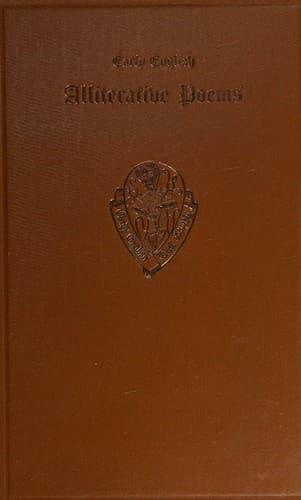
Early English Alliterative Poems: in the West-Midland Dialect of the Fourteenth Century
Religion
Early English Alliterative Poems: in the West-Midland Dialect of the Fourteenth Century
English poetry -- Middle English, 1100-1500
[Sidenote: God speaks fiercely to the whale, and he vomits out
the prophet on a dry space.]
The{n}ne oure fader to þe fysch ferslych biddeȝ,
Þat he hy{m} sput spakly vpon spare drye;
Þe whal wendeȝ at his wylle & a warþe fyndeȝ,
& þ{er} he brakeȝ vp þe buyrne, as bede hy{m} oure lorde. 340
[Sidenote: Jonah has need to wash his clothes.]
Þe{n}ne he swepe to þe sonde i{n} sluchched cloþes,
Hit may wel be þat mest{er} were his mantyle to wasche;
Þe bonk þat he blosched to & bode hy{m} bisyde,
Wern of þe regiou{n}es ryȝt þat he renayed hade; 344
[Sidenote: God’s word comes to the prophet.]
Þe{n}ne a wynde of goddeȝ worde efte þe wyȝe bruxleȝ,
“Nylt þ{o}u neu{er} to nuniue bi no-ky{n}neȝ wayeȝ?”
“Ȝisse lorde,” q{uod} þe lede, “lene me þy g{ra}ce
[Sidenote: He is told to preach in Nineveh.]
For to go at þi gre, me gayneȝ non[20] oþ{er}.” 348
“Ris, aproche þe{n} to prech, lo þe place here!
Lo! my lore is i{n} þe loke,[21] lance hit þer-{in}ne.”
Þe{n}ne þe renk radly ros as he myȝt,
[Sidenote: By night Jonah reaches the city.]
& to niniue þat naȝt he neȝed ful euen; 352
[Sidenote: Nineveh was a very great city.]
Hit watȝ a ceté ful syde & selly of brede,
On to þrenge þ{er}-þurȝe watȝ þre dayes dede.
[Sidenote: [Fol. 88a.]]
Þat on Io{ur}nay ful Ioynt Ionas hy{m} ȝede,
Er eu{er} he warpped any worde to wyȝe þ{a}t he mette, 356
[Headnote: THE PROPHET PREACHES AGAINST NINEVEH.]
Public-domain text, read in full here on John Shaqi.
Reviews
Reviews
No reviews yet
Be the first to share your thoughts on this work.
Elsewhere in the archive
Join the Discussion
Join the discussion
Sign in to leave a comment or review.
Sign InorCreate an account