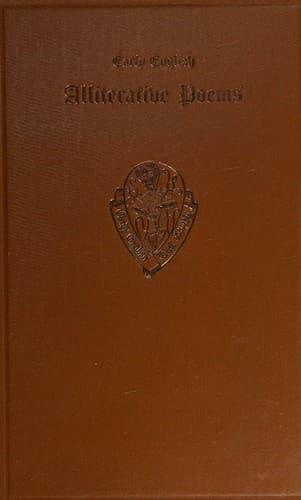
Early English Alliterative Poems: in the West-Midland Dialect of the Fourteenth Century
Religion
Early English Alliterative Poems: in the West-Midland Dialect of the Fourteenth Century
English poetry -- Middle English, 1100-1500
Bi-cnv, acknowledged, B. 1327.
Bidde, bide, abide. C. 51.
Biden, _p.p._ of _bide_ = _abide_, B. 616.
{Bifalle, Byfalle,} befal, A. 186.
Bifore, before, A. 49.
{Bigge, Bygge,} great, B. 43, _bygger_, A. 374.
Bigge, build, B. 1666. A.Sax. _byggan_. Icel. _byggia_. O.Sw. _bygga_,
build, also inhabit.
Bigly, strongly, C. 321. See T. B. 904.
Bigonne, began, B. 123.
Bihynde, behind, B. 918.
Biholde, behold, B. 150.
Bihyȝt, promised, C. 29.
Bikenne, give, hand over, B. 1296.
Bilde, built, B. 1392.
Bileue, remain, B. 1549.
Bilooghe, below, B. 116.
Birle, pour out, B. 1511. Prov.E. _burl_. A.S. _byrelian_, to give to
drink.
“And seruanz war at this bridale
That _birled_ win in cupp and schal.” --(Met. Hom. p. 120.)
Birolled, berolled, B. 959.
Biseche, beseech, B. 614.
Bisoȝten, besought, C. 375.
Bispeke, speak, C. 169.
Bisyde, beside, B. 926.
Bi-talt, aroused, A. 1161. A.S. _tealtian_, _tealtrian_; (1) to
_tilt_, shake; (2) to be in danger. William of Shoreham uses one
form of this word:
“For ȝef that water his kende lest
That cristninge stant _te-tealte_.” --(Poems, p. 9.)
“For if that water its kind loseth,
That christening standeth tottery, insecure” (_i.e._ not binding).
Biteche, give up to, entrust to, B. 871; pret. _bitaȝt_.
Bited, bit, C. 373.
{Biþenkke, Biþenke,} bethink, B. 1357.
Biþoȝt, bethought, B. 125.
Bityde, betide; _pret._ bitydde, C. 61.
Bityde, befall, B. 1804.
Blade, B. 1105.
Blake, black, A. 945; B. 747, 1449.
Blame, _vb._ A. 275; B. 877, 1661; _sb._ B. 43.
Blande, “in blande,” together, B. 885. See _blende_.
{Blasfamye, Blasfemyon,} B. 1661, 1712.
Blayke, yellow, A. 27. Brockett has _blayke_ with the sense of yellow,
of a golden colour. “_Bleyke_ of coloure.” Pallidus, subalbus.
(Prompt. Parv.)
“Ther (in paradyse) were floures bothe blew and _blake_,
Of alle frutes thei myth ther take.” --(Cov. Myst. p. 2.)
Blaȝt, white, A. 212, _p.p._ of _bleach_, just as _raȝt_ is of
_reach_. Sc. _blaucht_.
“As _blaȝt_ ere thaire wedis
As any snyppand snawe.” --(K. Alex. p. 54.)
Ble, colour, complexion, A. 76, 212; B. 791, 1759. Prov.E. _ble_,
_bly_. A.S. _bleo_.
Bleaunt, a robe of fine linen, A. 163. O.Eng. _bliant_, fine linen,
W. _llian_, linen. The _bl_ is merely an imitation of the Celtic
_ll_.
“A blewe _bleaunt_ obofe brade him al ovir.” --(K. Alex. p. 167.)
Blench, stratagem, device, B. 1202. O.N. _blekkia_.
Blemyst, blemished, B. 1421. O.Fr. _blesmir_.
{Blende, Blente,} blended, mingled, mixt. A. 385, 1016; B. 967, 1788.
A.S. _blendian_. Icel. _blanda_, to mix.
Blo = bla, blue, livid, pale. B. 1017; C. 134. O.H.G. _blao_, N.Fris.
_bla_. O.Sc. _bla_.
{Blober, Bluber,} = blubber, waves, C. 221, 266. Prov.E. _blubber_,
bubble; _blob_, _bleb_, a bubble. “_Blobure_ (blobyre, P.)
Burbulium.” (Prompt. Parv.) “_Blober_ upon water (or bubble)
Public-domain text, read in full here on John Shaqi.
Reviews
Reviews
No reviews yet
Be the first to share your thoughts on this work.
Elsewhere in the archive
Join the Discussion
Join the discussion
Sign in to leave a comment or review.
Sign InorCreate an account