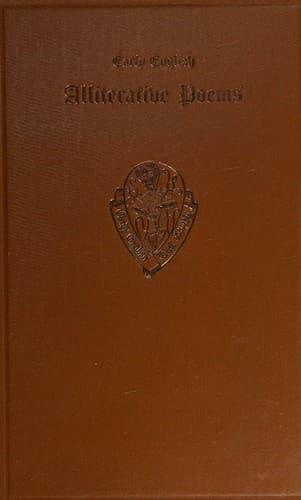
Early English Alliterative Poems: in the West-Midland Dialect of the Fourteenth Century
Religion
Early English Alliterative Poems: in the West-Midland Dialect of the Fourteenth Century
English poetry -- Middle English, 1100-1500
bouteillis.” (Palsg.) “The water _blubbers_ up.” (Baker,
Northamptonshire Glossary.)
Blod, a child, B. 686. Supposing the _bl_ to represent _ll_ we might
refer it to the W. _llawd_, a youth, _lad_. O.Sw. _g-lott_. Cf.
_bliant_, _bleant_, from W. _llian_.
“þis Abel was a blissid _blod_,
Bot Caim was the findes (devil’s) fode (offspring).”
--(Cott. MS. Vesp. A. iii. fol. 7b.)
Blod, blood, A. 650.
Blok, space, C. 272.
{Blom, Blome,} flower, bloom, A. 578, B. 1467. Sw. _bloma_, a flower.
Du. _bloeme_. Ger. _blume_. “_Blome_ flowre. Flos.” (Prompt. Parv.)
Blomeȝ, blooms, flowers, A. 27.
Blonk, horse, _pl._ _blonkeȝ_, B. 87, 1392. See T. B. 2371.
Blonkken, _gen. pl._ of horses, B. 1412.
Blosched, looked, C. 343. See _Blusch_.
Blose = blese, blaze, flame. A. 911. Icel. _blossi_, a flame. A.S.
_blaese_, a torch. Dan. _blus_.
Blot, spot, blemish, defilement, A. 782.
“Ye ben worthy, he saide, to be _blottede_ and _spottede_, foulede
and defoulede with fenne (mire) and with drit of water (_luto
inquinari_), and of blode, that in tyme of werre ne were nat be
bespreynt, ne be wette with ennemyes blode.” (Quoted by Way, from
Roy. MS. 18, A. xii. B. iii. c. 10.)
Blubrande = blubbering, bubbling, foaming, B. 1017. See _blobber_.
Blunt, rushed, C. 272.
Blunt, faint, A. 176. Icel. _blunda_, to sleep. Sw. _blunda_, to close
the eyes. Dan. _blende_, to dazzle. Cf. “Blunt of wytte. Hebes.”
(Prompt. Parv.)
{Blusch, Blusche,} look, glance, A. 980, 1083, B. 904, 998, 1537.
N.Prov.E. _blush_, resemblance. Cf. “At the first _blush_,” at the
first appearance, at first sight. Dan. _blusse_, to blaze, flame,
glow. There seems to be an etymological connection with words
signifying to look, glow, blaze, shine, etc.
“The kyng _blyschit_ on the beryne (man) with his brode eghne.”
--(Morte Arthure, p. 10.)
“He _blusshed_ ouer backeward to þe brodesee.” --(See T. B. 1316.)
{Blusnande, Blysnande,} shining, B. 1404. Icel. _blys_. Dan. _blus_,
a torch. Du. _blos_, redness. Dan. _blusse_, to glow. Icel. _lysa_,
to shine. Pl. D. _bleistern_, to glisten.
Bluster, B. 886, to wander or stray about.
“Ac there was wight noon so wys
The wey thider kouthe,
But _blustreden_ forth as beestes
Over bankes and hilles.” --(Piers Ploughman, p. 108.)
Blwe, blue, A. 423.
Blwe, blew, B. 885.
Blykked, shone, B. 603. A.S. _blican_, glitter, dazzle. Ger.
_blicken_, shine, glance, look. Du. _blicken_, glitter; _blick_,
a flash.
“Hire bleo _blyketh_ so bryht
So feyr heo is ant fyn.” --(Lyric Poems, p. 52.)
Blyknande, shining, B. 1467.
Blykned = blaykned, became black, B. 1759.
Blynde, to become faded, dull, B. 1126.
Blynne, cease, A. 729, B. 440, 1661, 1812. A.S. _blinnan_ (for
_be-linnan_).
{Blysfol, Blysful,} blissful, A. 279, 409.
Blysnande, shining, A. 163. See _blusnande_.
Public-domain text, read in full here on John Shaqi.
Reviews
Reviews
No reviews yet
Be the first to share your thoughts on this work.
Elsewhere in the archive
Join the Discussion
Join the discussion
Sign in to leave a comment or review.
Sign InorCreate an account