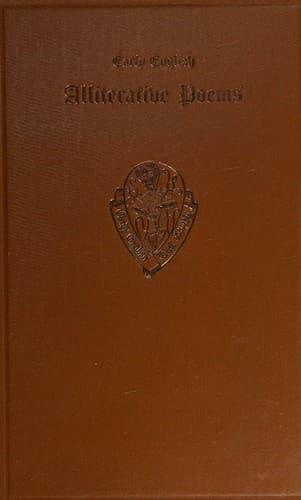
Early English Alliterative Poems: in the West-Midland Dialect of the Fourteenth Century
Religion
Early English Alliterative Poems: in the West-Midland Dialect of the Fourteenth Century
English poetry -- Middle English, 1100-1500
_bryd_, a bride, a wife, woman.
Brydde, bird, B. 288, 1482.
Brydale, wedding, marriage, B. 142.
{Brym, Brymme,} bank, shore, A. 232, 1074. Dan. _bremme_.
Brymme, stream, water, B. 365. A.S. _brym_, the sea. In this sense
_brymme_ seems to have been unknown to the Southern dialect.
“O þis water þat sua stanc
Wa was þam þat it nedings dranc,
Þat toþer oncom þat him felle,
Was frosse þat na tung moght telle,
Þat ute o _brim_ and brokes bred,
And siþen over al Egypte spred.”
--(Cott. MS. Vesp. A. iii. fol. 32b.)
Brynkeȝ, brinks, banks, B. 384.
Brynston, brimstone, B. 967.
Bryȝt, _adj._ bright, A. 110; _sb._ bright one, A. 755.
Bukkeȝ, bucks, B. 392.
Bulde, built, B. 1190.
Buleȝ, bulls, B. 392.
Bulk, stern of a ship. A.S. _bolca_, O.H.G. _pl._ _balkun_. Agiavia,
loca per quæ ad remiges acceditur. (Graff. iii. p. 108.)
{Bur, Burre,} blow, assault, A. 176; C. 7. O.Sc. _byr_, a blow.
N.Prov. _birre_, _burr_. W. _bur_, violence, rage. See Wicliffe, St.
Luke, viii. 33.
“---- no buerne might ffor the _birre_ it abide.”
--(T. B. 170. Cf. T. B. 571, 1902.)
Bur, wave, C. 148. Prov.E. _bore_. Icel. _bara_. O.Ger. _bare_. Du.
_baar_, wave, billow. In Laȝamon, vol. iii. p. 121, _Þe beares_
occurs in the latter version for _þa vðen_ of the older copy.
Burde, behoved, A. 316; C. 117, 507. O.N. _byrjar_. Dan. _bör_.
Burde, a woman, lady. B. 80, 653. See _Bryd_. See T. B. 3984.
{Burghe, Burȝ, Burȝe,} city, town, A. 980; B. 982; C. 366.
Burne, man, A. 397, 712; B. 1202; “_burneȝ & burdeȝ_,” men and women,
B. 80. A.S. _beorn_, warrior, hero.
{Burnist, Burnyst,} burnished, B. 1085.
Burre, blow, A. 176. See _bur_.
Burþen, burden, B. 1439.
Butter, B. 636.
Burȝ, city, town, B. 1666. See _burghe_.
{Busch, Busche,} = buske, to go, B. 1416; C. 143, 472.
“& he (she) wist it as wel or bet as ȝif it were hire owne,
Til hit big was & bold to _buschen_, on felde.”
--(William and the Werwolf, p. 7.)
Busily, laboriously, B. 1446.
Busk, prepare, made ready, dress, to direct one’s steps towards a
place, to go, hasten. B. 142, 333, 351, 633, 1395; C. 437. Icel. _at
buast_ (for _at buasc_) = _at bua sig_, to bend one’s steps, to
prepare, etc. See T. B. 1186.
Busmar, scorn, mockery, B. 653. A.S. _bismer_, reproach, blasphemy.
Bustwys, impetuous, fiery, A. 911. See _bostwys_.
Busyeȝ = busies, troubles, A. 268.
Buyrne = burne, man, C. 340. See _Burne_.
Bycalle, call, A. 913.
Bycalt, aroused, called, A. 1163.
Bycom, became, A. 537.
Byde, abide, A. 399; suffer, A. 664; B. 32; remain, B. 449, 622.
Bydene, quickly, A. 196.
Bye, buy, A. 732.
Byfallen, befallen, B. 1629.
Byfore, before, A. 530.
{Bigge, Byge,} great, B. 229.
{Byggyng, Bygyng,} building, A. 932; dwelling, B. 378. A.S. _byggan_,
to build, Icel. _byggia_. See T. B. 1379.
Bygly, great, strong; “_bygly bylde_,” great building, A. 963.
Public-domain text, read in full here on John Shaqi.
Reviews
Reviews
No reviews yet
Be the first to share your thoughts on this work.
Elsewhere in the archive
Join the Discussion
Join the discussion
Sign in to leave a comment or review.
Sign InorCreate an account