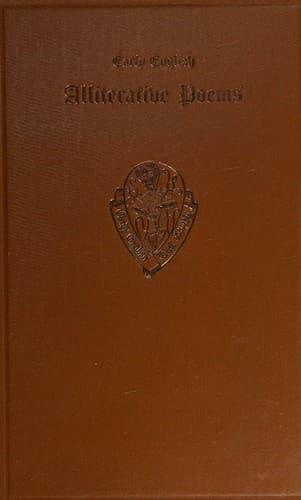
Early English Alliterative Poems: in the West-Midland Dialect of the Fourteenth Century
Religion
Early English Alliterative Poems: in the West-Midland Dialect of the Fourteenth Century
English poetry -- Middle English, 1100-1500
{Breth, Brethe,} wind, C. 107, 138; smell, vapour, B. 509, 967. Cf.
“_brethe_ of smoke.” (Hampole’s Pricke of Conscience, l. 4727.) Sc.
_broth_. Ger. _brodem_, _broden_, steam, vapour. A.S. _bræth_, an
odour, scent, breath. “_Brethe_ at his wille.” (T. B. 1945.)
Breth, wrath, B. 916. See _Brath_.
Breue, tell, A. 755.
“_Breve_ us thi name.” (K. Alex. p. 78.)
Breued, related, written, B. 197. O.N. _brefa_.
Breyþed, rushed, B. 1421. See _Braid_.
Brod, great; “_brod_ wonder,” B. 584.
Brode, broad, A. 650.
{Brok, Broke,} brook, river, stream, A. 981; _pl._ _brokeȝ_. A. 1074,
sea; C. 145. A.S. _broca_.
Brom (broom), heath, C. 392. A.S. _bróm_.
Bronch, branch, B. 487.
Bronde, sword, B. 1246. O.N. _brandr_.
Brond, brand, B. 1012.
Broþe, angry, fierce, rough, B. 149, 1409. The original form in O.E.
is _brathe_. It is connected with _brethe_, _brathe_, anger, wrath.
“Wreth it es a _brath_ on-fall (outburst)
Menging o mode that cums o galle.”
--(The Deadly Sins, in Cott. MS. Vesp. A. iii.)
{Broþely, Broþlych,} fierce, rough, and hence vile, bad, B. 848, 1030;
vilely, B. 1256; C. 474. The original form is _braþly_, fiercely,
vigorously.
“Thoner o-loft fal sal he (Antichrist) gar,
And tres _brathli_ blomes bere;
_Brathli_ to do the see be reth (stormy)
And _brathli_ to do it be smeth.”
--(Cott. MS. Vesp. A. iii. fol. 124a.)
Broun, brown, A. 537, 990.
Browden, clustered, B. 1132.
Broȝt, brought, A. 286.
Brugge = brigge, bridge, B. 1187. A.S. _bricge_.
Brunt, blow, A. 174.
“All þat was bitten of the best (beast)
was at a brunt dede.” --(K. Alex. p. 134.)
Brurd, border, edge, B. 1474. Sc. _breard_. A.S. _brerd_, _breard_,
_briord_, _breord_, brim, margin, rim, shore, brink.
Brurd-ful, brimful, full up to the brim, B. 383. Chaucer uses
_bret-ful_ in the same sense.
Brutage = bretage, parapets of a wall, ramparts, B. 1190. Fr.
_breteche_.
Bruxle, upbraid, reprove, C. 345. O.N. _bríxla_, to reprove, reproach.
Brych, filth, uncleanness, B. 848. The meaning here assigned to
_brych_ is conjectural. Cf. Du. _brack_, refuse, damaged. Ger.
_brechen_, to vomit, _Bryche_ as an adjective occurs in Robt.
Brunne’s “Handlyng Synne,” p. 182, where it is glossed low (loghe)
_i.e._ vile.
“Now ys Pers bycome _bryche_
That er was bothe stoute and ryche.”
In the Romance of Alexander, ed. Stevenson, we find the form
_bicchid_ = _briched_ (?). Cf. _shille_ and _shrille_, etc.
“And on the aȝtent day, eftire the prime
A basilisk in a browe, breis (annoys) thaim unfaire,
A straȝtill and a stithe worme _stinkande_ of elde,
And es so bitter, and so breme, and _bicchid_ (foul) in himselfe,
That with the _stinke_ and the strenth he stroyes noȝt allane,
Bot quat he settes on his siȝt, he slaes in a stonde.” --(p. 165.)
Bryd, lady, A. 769. A.S.
Public-domain text, read in full here on John Shaqi.
Reviews
Reviews
No reviews yet
Be the first to share your thoughts on this work.
Elsewhere in the archive
Join the Discussion
Join the discussion
Sign in to leave a comment or review.
Sign InorCreate an account