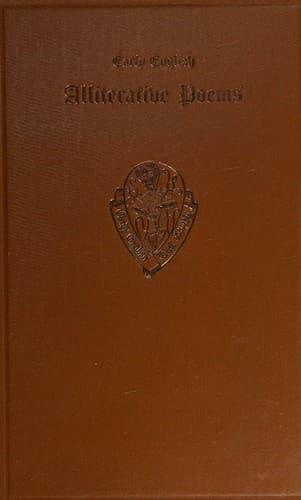
Early English Alliterative Poems: in the West-Midland Dialect of the Fourteenth Century
Religion
Early English Alliterative Poems: in the West-Midland Dialect of the Fourteenth Century
English poetry -- Middle English, 1100-1500
Labour, _sb._ A. 634; _vb._ A. 504.
{Lache, Lachche,} = latch, take, receive, B. 166; _lached_, received,
B. 1186; taken, C. 266; reach, C. 322; “_lach_ out,” take away,
C. 425. A.S. _læccan_.
Lad, led, A. 801.
Ladde = lad, man (of inferior station), B. 36; C. 154. O.H.G. _laz_,
libertinus. Ger. _lasse_. Du. _laete_, a peasant.
Ladde-borde, larboard, C. 106.
Laddres, ladders, B. 1777.
Lade, led, A. 1146.
Ladyly, A. 774.
Ladyschyp, A. 578.
Lafte, left, B. 1004.
Laften, (_3d pers. pl. pret._) left, A. 622; C. 405.
{Lake, Llak,} lake, deep, B. 438, 536.
Lakke, sin against, abuse, B. 723. Dan. and Sw. _lak_, fault, vice.
Dan. _lakke_, decay, decline.
{Lalled, Laled,} spoke, B. 153, 913. Dan. _lalle_, to prattle.
Bavarian _lallen_, to speak thick, talk. Gr. λαλειν, to
talk.
Lance, take, C. 350.
Langage, language, B. 1556.
Langour, sorrow, A. 357.
Lansed (? _laused_), uttered, B. 668; C. 489. _Launch_, in the dialect
of Worcestershire, signifies to cry out, groan.
Lansed, ? quaked, B. 957.
Lanteȝ (? _lanceȝ_), lentest, gavest, B. 348.
Lantyrne, A. 1047.
Lape, lap, taste, B. 1434. _Lape_, lape, taste (Baker’s Northampton
Glossary).
Lappe, _sb._ A. 201. A.S. _læppa_, border, hem. “_Lappe_, skyrte
(_lappe_, barme, K.). Gremium.” (Prompt. Parv.)
“The word _lap_, according to many ancient writers, signified the
skirt of a garment. Thus G. de Bibelsworth says,
‘Car par deuant avez eskours (_lappes_),
Et d’en costé sont vos girouns (sidgoren).’
It denoted, likewise, the hinder skirt.” (Way in Prompt. Parv.)
Lapped, folded, clothed, B. 175. See T. B. 236.
Lasched, B. 707. ? became hot, lascivious.
Lasned = lessened, made smaller, B. 438, 441.
Lasse, less, A. 599, 600; B. 1640.
Laste, follow, A. 1146; C. 320. A.S. _last_, footstep. Goth,
_laistjan_, to follow after.
Laste, fault, crime, C. 198.
Lastes, becomes faulty, B. 1141. Dan. _last_, vice, fault. O.N.
_löstr_. S.Sax. _last_, calumny, blame. Icel. _last_. Ger.
_lästerung_, slander.
Lat, slow, late, B. 1172. A.S. _læt_, slow, late. Cf. _“lat_-a foot,
slow in moving.” (Wilbraham’s Cheshire Glossary.)
Laþe, to invite, B. 81. A.S. _lathian_. O.Sax. _lathian_. O.N. _lada_.
Prov.E. _lathe_, to invite. A.S. _lathu_, invitation. N.Prov.E.
_lathing_, invitation.
Lauce, loosen, do away with (?), B. 1589.
Laue, law, B. 723.
Lauande, pouring, flowing, B. 366.
Laue, pour out, A. 607; C. 154. A.S. _lafian_.
Launceȝ, branches (of trees), A. 978.
Launde, an open space between woods, a park; _lawn_, B. 1000, 1207.
“_Saltus_ a lawnd.” (Nominale MS.) Welsh _llan_. “_Lawnde_ of a
wode. Saltus.” (Prompt. Parv.) “_Indago_, a parke, a huntynge place,
or a _launde_.” (Ortus.) “_Lande_, a _land_ or _launde_, a wild
untilled shrubbie or bushy plaine.” (Cotg.) O.Fr. _lande_, saltus.
“Sythyne [he] wente into Wales wyth his wyes alle;
Public-domain text, read in full here on John Shaqi.
Reviews
Reviews
No reviews yet
Be the first to share your thoughts on this work.
Elsewhere in the archive
Join the Discussion
Join the discussion
Sign in to leave a comment or review.
Sign InorCreate an account