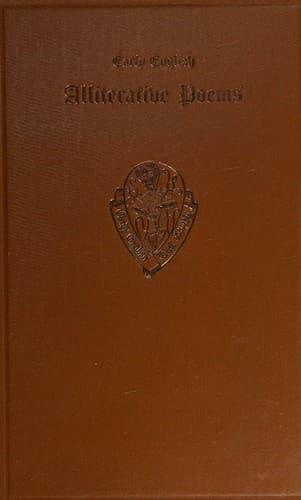
Early English Alliterative Poems: in the West-Midland Dialect of the Fourteenth Century
Religion
Early English Alliterative Poems: in the West-Midland Dialect of the Fourteenth Century
English poetry -- Middle English, 1100-1500
Sweys into Swaldye with his snelle houndes,
For to hunt at the hartes in thas hye _laundes_.”
--(Morte Arthure, p. 6.)
Lawe, hill, B. 992. Sc. _law_. A.S. _hlæw_, mound, mount. Goth.
_hlaiw_.
Lawles, C. 170.
Lay, put down, B. 1650.
Layke, _sb._ sport, play, amusement, B. 122, 1053.
Layke, _vb._ to play, B. 872. A.S. _lác_, play; _lácan_, to play.
Layke, device, B. 274; C. 401.
Layned, kept secret, A. 244. N.Prov.E. _lane_, to hide. O.N. _leyna_.
Layth, vile, evil, C. 401. A.S. _láth_, evil, harm; _láth_, hateful,
evil; “_laithe_ hurtes,” T. B. 1351.
Layte, seek, search, B. 97, 1768. N.Prov.E. _late_. Icel. _leita_. Sw.
_leta_, to look for; “_laytyng_ aboute,” T. B. 2348.
Laȝares, lepers, B. 1093.
Laȝe, laugh, B. 653, 661.
{Laȝte, Laȝt,} = laught, took, A. 1128, 1205. See _Lache_.
Le, shelter, C. 277. A.S. _hleo_, shade, shelter. Cf. T. B. 2806. O.N.
_hlja_, to protect. Cf. _Leeside_ = the sheltered side of a ship.
“---- thar I the tell
Is the richt place and sted for ȝour cite,
And of ȝour travell ferm hald to rest in _le_.”
--(G. Doug. vol. i. p. 152.)
“Þe wicked alsua þe gode sal se,
Wit-in þair gamen stad and gle,
Þat þai þe sorfuller sal be,
Þat losen folili has þat _le_.” (_i.e._, heaven).
--(“De Penis,” quoted in “Hampole’s Pricke of Conscience,” l. 4,
p. xii.)
Leauty, loyalty, B. 1172.
Lebarde, leopard, B. 536.
Lecherye, B. 1350.
{Led, Lede,} man, person, A. 542; B. 412. A.S. _leód_, man.
{Led, Leede,} people, nation, B. 691, 772, 909. A.S. _leóde_, people,
folk.
Ledden = leden, sound, A. 878. Chaucer uses the word _leden_ in the
sense of _speech_, _language_. A.S. _hlyd_. O.N. _hliod_, a sound.
Ledisch, national, pertaining to a people or country, B. 1556. S.Sax.
_leodisce_. See _Lede_.
{Leef, Lef,} _adj._ dear, precious; _sb._ dear one, wife, A. 266, 418;
B. 772, 939, 1066. A.S. _leóf_.
Lefly, dear, beloved, B. 977. A.S. _leóflíc_.
Lefsel, bower, house formed of leaves, C. 448.
“By a lauryel ho (Dame Gaynour) lay, vndur a _lefe-sale_,
Of box and of barberè, byggyt ful bene.”
--(The Anturs of Arther in Robson’s Met. Rom. p. 3, vi. 5.)
“With _lefsales_ uppon lofte lustie and faire.” (T. B. 337.)
A.S. _leaf_, a leaf, and _sel_, dwelling, hall. Sw. _löfsal_, a hut
built of green boughs. _Levesel_ (another form of _lefsel_) is used
by Chaucer (Reve’s Tale, 4059), but is left unexplained in the
glossary to Wright’s edition. Tyrwhitt’s derivation of this term
from A.S. _lefe_, folium, and _setl_, sedes, is certainly very near
the mark. Cf. “_levecel_ beforne a wyndowe, or other place.
Umbraculum.” (Prompt. Parv.)
Lege, liege, subject, B. 94, 1174.
Legioune, A. 1121, B. 1293.
Lel, true, B. 425. “Leve this for _lell_.” T. B. 239.
Lelly, truly, faithfully, A. 305; B. 1066. See T. B. 420.
Leme, glide away, A. 358.
Public-domain text, read in full here on John Shaqi.
Reviews
Reviews
No reviews yet
Be the first to share your thoughts on this work.
Elsewhere in the archive
Join the Discussion
Join the discussion
Sign in to leave a comment or review.
Sign InorCreate an account