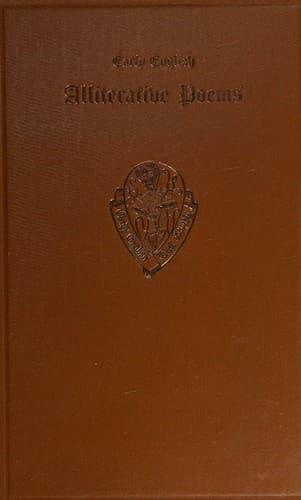
Early English Alliterative Poems: in the West-Midland Dialect of the Fourteenth Century
Religion
Early English Alliterative Poems: in the West-Midland Dialect of the Fourteenth Century
English poetry -- Middle English, 1100-1500
These forms are evidence of a broad pronunciation which, at the present
time, is said to be a characteristic of the northwestern division of
Lancashire, but I think that there is good evidence for asserting that
this strong provincialism was not confined, formerly, to the
West-Midland dialect, much less to a division of any particular county.
We find traces of it in Audelay’s Poems (Shropshire), the Romance of
William and the Werwolf,[35] and even in the Wickliffite version of the
Scriptures.
Formerly, being influenced by these broad forms, I was led to select
Cheshire or Staffordshire as the probable locality where the poems were
written; but I do not, now, think that either of these counties ever
employed a vocabulary containing so many Norse terms as are to be found
in the Lancashire dialect. But although we may not be able to fix, with
certainty, upon any one county in particular, the fact of the present
poems being composed in the West-Midland dialect cannot be denied. Much
may be said in favour of their Lancashire origin, and there are one or
two points of resemblance between our poems, the Lancashire Romances,
and Liber Cure Cocorum, that deserve especial notice.
I. In Sir Amadace,[36] lxviii. 9, there occurs the curious form _miȝtus_
= _miȝtes_ = _mightst_.[37] As it appears only once throughout the
Romances we might conclude that it is an error of the scribe for
_miȝtest_, but when we find in the poems before us not only _myȝteȝ_ =
_myȝtes_ (mightst), but _woldeȝ_ = _woldes_ (wouldst), _coutheȝ_ =
_couthes_ (couldst), _dippteȝ_ (dippedest), _travayledeȝ_ (travelledst),
etc., we are bound to consider _miȝtus_ as a genuine form.[38] In no
other Early English works of the fourteenth century have I been able to
find this peculiarity. It is very common in _the Wohunge of Ure Lauerd_
(xiiith cent.). See O.E. Homilies, p. 51. The Northumbrian dialect at
this period rejected the inflexion in the second person preterite
singular, of regular verbs,[39] and in our poems we find the _-es_ often
dropped, so that we get two conjugations, which may be called the
inflected and the uninflected form.
Inflected. Uninflected.
1st pers. hopede hoped (I) hoped.
2nd „ hoped_es_ hoped (thou) hopedest.
3rd „ hopede hoped (he) hoped.
Originally the inflected form may have prevailed over the whole of the
North of England, but have gradually become confined to the West-Midland
dialect.
II. The next point of resemblance is the use of the verb SCHIN or SCHUN
= schal = shall. It is still preserved in the modern dialect of
Lancashire in combination with the adverb _not_, as schunnot[40] = shall
not. The following examples will serve to illustrate the use of this
curious form:--
“---- þay _schin_ knawe sone,
Þere is no bounté in burne lyk Baltaȝar þewes.”[41] --(B. l. 1435.)
“& þose þat seme arn & swete _schyn_ se his face.”[42]
--(_Ibid._ l. 1810.)
Public-domain text, read in full here on John Shaqi.
Reviews
Reviews
No reviews yet
Be the first to share your thoughts on this work.
Join the Discussion
Join the discussion
Sign in to leave a comment or review.
Sign InorCreate an account