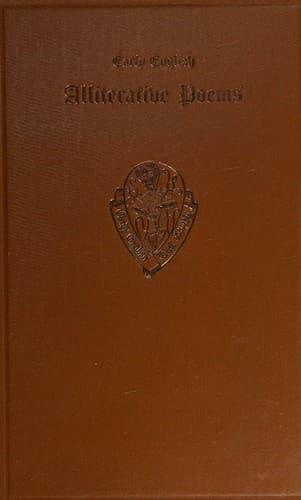
Early English Alliterative Poems: in the West-Midland Dialect of the Fourteenth Century
Religion
Early English Alliterative Poems: in the West-Midland Dialect of the Fourteenth Century
English poetry -- Middle English, 1100-1500
_mota_, hill or mound. O.Fr. _mote_.
“Þe bryght ceté of heven is large and brade,
Of whilk may na comparyson be made
Tille na ceté þat on erth may stand,
Ffor it was never made with mans hand.
Bot yhit, als I ymagyn in my thoght,
I lyken it tylle a ceté þat war wroght
Of gold, of precyouse stones sere,
Opon a _mote_, sett of berylle clere,
With walles, and wardes, and turrettes,
And entré, and yhates, and garrettes.”
--(Hampole’s Pricke of Conscience, p. 239, l. 8896.)
MS. Lansd. 348, reads _mount_ for _mote_.
{Moteles, Moteleȝ,} spotless, A. 899.
Moul = mould, earth, A. 23.
Moun (_3rd pers. pl._ of _mowe_, to be able), are able, A. 536.
Mount, A. 868; B. 447.
Mountaunce, amount, C. 456.
Mountayne, B. 385.
{Mountes, Mounteȝ,} = amounts, avails, A. 351; C. 332.
Mourkenes, _mirkens_, becomes dark, B. 1760. O.N. _myrka_, to darken,
Dan. _mörkne_.
Mourkne, to rot, become rotten, B. 407. From this verb is derived the
O.E. _morkin_, a dead beast, carrion, a scarecrow. O.N. _morkinn_,
rotten; _morkna_, to rot.
Mourne, to mourn, C. 508.
Moȝt, might, could, B. 1108, 1668.
Mudde, B. 407.
Mukel, great, B. 52, 366, 1164. O.N. _mikill_.
Mul, dust, dirt, A. 905; B. 736. See _Mol_.
Multyplyed, B. 278.
Mun, C. 44. This may be another form of _mon_ = moan. But the phrase
“_maugre his mun_,” leads us to reject this interpretation. _Maugre_
is generally used with some part of the body, as “_mawgre his
tethe_,” “_maugre his chekes_,” etc. _Mun_ may therefore signify the
mouth. (Sw. _mun_, a mouth.) The term is still retained in the north
of England. Halliwell quotes the following:
“A common cry at Coventry on Good Friday is--
‘One a penny, two a penny, hot cross buns,
Butter them and sugar them and put them in your _muns_.’”
Munster = minster, church, cathedral, temple, B. 1267; C. 268.
Munt, purpose, A. 1161. N.Prov.E. _munt_, a hint. See _Mynt_.
Murte, break, crush, C. 150. Pl. D. _murten_, to crush. See
_to-murte_. In T. B. 4312 we have _myrte_ = to crush. Bothe
mawhownus & maumettes _myrtild_ in peces.
Myddeȝ, midst, A. 740. See _In-myddeȝ_.
Mydnyȝt, midnight, B. 894.
Myke, _sb._ B. 417. Cf. Du. _mik_. The crutches of a boat, which
sustain the main boom or mast and sail when they are lowered for the
convenience of rowing.
Mykeȝ, free labourers (?), A. 572. A.S. _mecg_, a man. In the _Cursor
Mundi_, Cott. MS. Vesp. A. iii. fol. 17, the angels are represented
as speaking to Lot as follows:
“‘Has þou her,’ þai said, ‘ani man,
Sun or doghter, _mik_ or mau,
To þe langand, or hei or lau
Þou lede þam suith out o þis tun
Ar þat hit be sunken don.’”
But ? _be mykeȝ_ = he _mykeȝ_, he chooses.
Myneȝ, “_me myneȝ_,” I remember, B. 25. A.S. _mynan_, to remember.
O.N. _minna_.
Mynge, record, mention, A. 855. A.S. _myngian_, to remind.
Public-domain text, read in full here on John Shaqi.
Reviews
Reviews
No reviews yet
Be the first to share your thoughts on this work.
Elsewhere in the archive
Join the Discussion
Join the discussion
Sign in to leave a comment or review.
Sign InorCreate an account