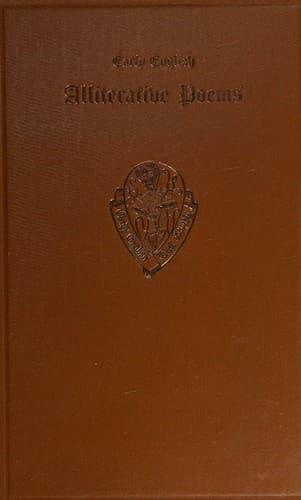
Early English Alliterative Poems: in the West-Midland Dialect of the Fourteenth Century
Religion
Early English Alliterative Poems: in the West-Midland Dialect of the Fourteenth Century
English poetry -- Middle English, 1100-1500
Mynne, recollect, remember, A. 583; B. 436, 771. See T. B. 1434. See
_Myneȝ_.
Mynte, devise, purpose, B. 1628. A.S. _myntan_, _myntian_ to dispose,
settle, appoint. “_Myntyn’_ or _amyn’_ towarde for to assayen.
Attempto.” (Prompt. Parv.)
Mynstralsy, B. 121.
Mynyster, minster, temple, A. 1063.
Mynystre, _vb._ B. 644.
Myre, B. 1114.
Myrþeȝ, joys, A. 140.
Myrþeȝ, gladdens, A. 862.
{Myri, Myry,} = merry, pleasant, A. 23, 158; B. 417, 804; _myryer_,
A. 850; _myryest_, A. 435.
Myryly, pleasantly, joyously, B. 493.
{Mys, Mysse,} wrong, sin, A. 262; C. 420.
Myserecorde, mercy, A. 366.
Myse-tente, misunderstood, A. 257.
Mysse, to lose, A. 329; B. 189. O.N. _missa_, to lose. Du. _missen_,
to fail, miss.
Mysse, loss, grief, A. 364.
Mysseleue, unbelief, B. 1230.
Mysse-payed, displeased, C. 399.
Mysse-ȝeme, mis-use, A. 322.
Myst, B. 1760.
Myste, mysteries, secrets, (?), A. 462.
Mysterys, A. 1194.
Myþe, to trouble, weary (?), A. 359. A.S. _méthe_, wearied; _méth_,
feeble.
Myȝt, might, A. 630.
Myȝtes = mights, powers, B. 644, 1699.
Nadde = ne hadde, had not, B. 404.
Nakeryne (_gen. pl._ of _naker_), B. 1413; _naker_, _nacaire_, seems
to signify a kettle-drum.
Nas = ne was, was not, B. 727, 983.
Nature, A. 749.
Nauel, C. 278.
Naule, nail, A. 459.
{Nauþeleȝ, Nawþeles,} nevertheless, A. 877, 950.
{Nauþer, Nawþer,} neither, A. 1087; B. 1226.
Nawhere, nowhere, A. 534.
Nay, refuse, deny, B. 805.
Nayed, refused, B. 65.
Nayt, use, employ, B. 531. See T. B. 1038. A.S. _neotan_. O.N. _nyta_.
Naytly, neatly, dexterously, B. 480. See T. B. 2427. Nestor, a noble
man, _naitest_ in werre. T. B. 1038. N.Prov.E. _nately_, neatly.
Naȝte, night, A. 1203; B. 484, 807, 1002.
Ne, nor, B. 1226.
Nece, niece, A. 233.
Nedde, needed, A. 1044; hem nedde = they needed.
{Nede, Nedeȝ,} of necessity, A. 344.
Nedleȝ, needless, useless, B. 381; C. 220.
Nee = ne, nor, A. 262.
Nel, ne wille, will not, B. 513.
Nem, took (_pret._ of _nimme_), A. 802; B. 505.
Nemme, name, A. 997. See T. B. 152.
Nente, ninth, A. 1012.
Nere, _ne were_, were not, B. 21.
{Nere, Ner,} near, nigh, A. 286, 404; _wel ner_, nearly, B. 1585.
Nerre, nearer, A. 233; C. 85.
Nesch, gently, A. 606. A.S. _hnesc_, soft, tender.
Neue, fist, hand, B. 1537. N.Prov.E. _neve_, _neif_, a fist. O.N.
_hnefi_.
Neuen, name, B. 410, 1376, 1525. O.N. _nafn_, a name; _nefna_, to
name.
{Neȝ, Neȝe,} nigh, near, A. 528; B. 803.
{Neȝ, Neȝe, Neȝen,} approach, B. 32, 143, 805, 1017, 1754.
Nice, _adj._ foolish, B. 1354; _sb._ B. 1359. Fr. _nice_, foolish,
simple.
Nif, ne-if, if not, B. 30.
Niye, trouble, B. 1002.
Noble, A. 1097.
Nobley, nobleness, B. 1091.
No-bot, only, B. 1127. N.Prov.E. _no-bot_.
Nok, nook, C. 278.
Nolde, ne wolde, would not, B. 805, 1091.
{Nom, Nome,} took, A. 587; B. 1613; _pret._ of _nimme_, to take.
Nome, name, A. 872.
Public-domain text, read in full here on John Shaqi.
Reviews
Reviews
No reviews yet
Be the first to share your thoughts on this work.
Elsewhere in the archive
Join the Discussion
Join the discussion
Sign in to leave a comment or review.
Sign InorCreate an account