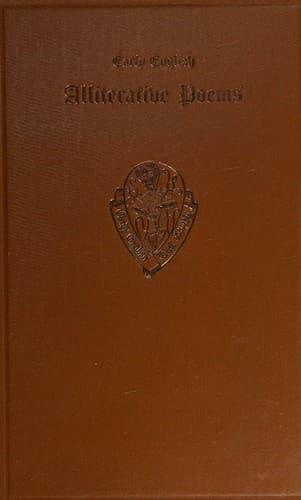
Early English Alliterative Poems: in the West-Midland Dialect of the Fourteenth Century
Religion
Early English Alliterative Poems: in the West-Midland Dialect of the Fourteenth Century
English poetry -- Middle English, 1100-1500
_Parcæ_. Dan. _valkyrier_.
Wallande, boiling, bubbling up, A. 365. A.S. _weallan_, to boil up.
Walle-heued = well-head, spring, B. 364.
{Walt, Walte,} rolled, turned, B. 501, 1734. Prov.E. _walt_, _welt_.
A.S. _wealtian_, to roll. O.N. _vella_.
“Hit _walt_ up the wilde se.” --(T. B. 4633.)
Walter, roll, flow, B. 415, 1027; C. 142. O.Sc. _welter_, _walter_.
Dan. _vælte_, to roll. See _Walt_.
Waltereȝ, an error for watterez = waters? C. 263.
Walterande, swimming, C. 247.
Walteȝ, pours, rushes, flows, B. 364, 1037. See _Walte_, T. B. 3699,
4632.
Wame, belly. See _Wombe_.
Wamel, to wamble, C. 300. O.N. _vambla_. Dan. _vamle_, to wamble, to
create or cause a squeamishness or loathing. “_Wamelyn’_ in the
stomake. Nauseo.” “_Wamelynge_ of the stomake, Nausia.” (Prompt.
Parv.)
Wan (_pret._ of _wynne_), got, reached, A. 107; B. 140.
Wap, a step, C. 449. O.N. _vapp_. It is generally explained by a blow,
stroke, which was probably its original meaning.
“The werld wannes at a _wappe_ and the wedire gloumes.”
--(K. Alex. p. 141.)
“It (worldly wealth) wites away at a _wapp_, as the wynd turnes.”
--(_Ibid._ p. 181.)
See T. B. 207, 6405.
Wappe, to strike, knock, B. 882.
War, aware, A. 1096; crafty, B. 589. A.S. _wær_, wary. O.N. _var_.
{War, Ware,} guard, beware, B. 165, 545, 1133. A.S. _wárian_.
Warded, guarded, C. 258. A.S. _weardian_, to guard.
Ware, were, A. 151.
Warisch, protect, B. 921.
Warlaȝe, wizard, B. 1560. See _Warlow_.
Warlok, prison, C. 80.
Warlow, a monster, C. 258. A.S. _wér-loga_, a liar, a faith-breaker.
“Þe warlaȝ was wete of his wan atter.” --(T. B. 303.)
Warne, bid, C. 469.
Warnyng, _sb._ B. 1504.
{Warpe, Warpen,} cast, hurl, B. 444; ejaculate, utter, A. 879; B. 152,
213. O.N. _varpa_. A.S. _weorpan_, to throw, cast.
Warþe, a water-ford, C. 339. A.S. _warth_, _waroth_, the shore.
Wary, curse, B. 513. A.S. _wærgian_, to curse.
Waryed, accursed, B. 1716.
Wassayl, B. 1508.
{Wast, Waste,} destroy, B. 326, 431, 1178. A.S. _wéstan_.
Wasturne, a wilderness, B. 1674. _Wasterne_ signifies a desert place,
from the A.S. _wéste_, desert, barren, and _ærn_, a place.
“Methoughte I was in a wode willed myne one,
That I ne wiste no waye whedire that I scholde,
Ffore wolueȝ and whilde swynne, swykkyde bestez,
Walkede in that _wasterne_ wathes to seche.”
--(Morte Arthure, p. 270.)
Wate = wot, know, A. 502. A.S. _witan_ (_Ic wát_, _þu wást_, _he
wát_).
Water, stream, A. 107, 139; river, B. 1380.
Wauleȝ, shelterless, from the A.S. _wáh_, a wall (?), C. 262. We
should perhaps read wanleȝ = wonleȝ, hopeless, from the A.S. _wén_.
O.N. _von_. O.E. _wone_, hope.
Wawe, wave, A. 287; B. 382; C. 142. A.S. _wæg_.
Wax, increase, B. 521.
Waxlokes, waves (?), B. 1037.
Wayferand, wayfaring, B. 79.
Waykned, weakened, B. 1422. O.N. _veikr_. A.S. _wác_, weak; _wácan_,
Public-domain text, read in full here on John Shaqi.
Reviews
Reviews
No reviews yet
Be the first to share your thoughts on this work.
Elsewhere in the archive
Join the Discussion
Join the discussion
Sign in to leave a comment or review.
Sign InorCreate an account