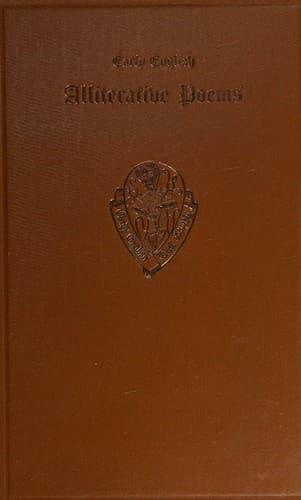
Early English Alliterative Poems: in the West-Midland Dialect of the Fourteenth Century
Religion
Early English Alliterative Poems: in the West-Midland Dialect of the Fourteenth Century
English poetry -- Middle English, 1100-1500
to become weak.
Wayle, select, choice, B. 1716. See _Wale_.
Waymot, passionate, C. 492. A.S. _weamod_.
Wayne, give, B. 1504; gain, recover, 1616, 1701. The original meaning
seems to be that of gaining, getting. O.Fr. _gaagnier_. In some O.E.
works _wayne_ is used like our word _get_.
“Than past up the proude quene into prevé chambre,
_Waynes_ (_i.e._ puts out her head) out at wyndow and waytes
aboute.” --(K. Alex. p. 33.)
Wayte, look into, search, B. 99; be careful, B. 292; look about,
B. 1423; inquire, B. 1552. See T. B. 876. “_Waytyn_ or _aspyyn_,
observo.” (Prompt. Parv.)
Waȝeȝes, _waȝes_, waves, B. 404.
“Girdon ouer the grym _waghes_.” --(T. B. 1410.)
See _Wawe_.
Webbe, cloth, A. 71.
Wedde, A. 772; B. 69.
Wedded wyf, B. 330.
Weddyng, A. 791.
{Wed, Wede,} garments, weeds, A. 748, 766; B. 793. A.S. _wæd_.
{Wed, Wede,} become mad, B. 1585. A.S. _wédan_, to rave, be mad.
Weder, storm, B. 444, 948.
Weder, weather, B. 1760.
Wela-wynnely, very joyfully, B. 831. A.S. _welig_, rich, bountiful;
_wyn_, pleasure, joy.
{Welcom, Welcum,} B. 813.
Welde, govern, rule, wield, B. 195, 835; use, employ, possess, B. 705,
1351; C. 16. A.S. _wealdan_, rule, exercise, possess.
Welder, ruler, C. 129.
Wele, joy (_pl._ _weleȝ_), A. 14, 154, 394; B. 651; C. 262. A.S.
_wela_.
Welgest, worthiest, B. 1244. A.S. _welig_ (_welga_), rich, wealthy.
Welke, walked, A. 101.
Welkyn, welkin, the sky. A.S. _welcn_, _wolcen_. O.Sc. _walk_,
a cloud.
Welle-hedeȝ, springs, B. 428.
Welt, revolved, C. 115. See _Walter_.
Welwed, faded, C. 475. A.S. _wealwian_.
“The grond stud burrant, widderit dosk or gray,
Herbis, flowris and gersis _wallowyt_ away.”
--(G. Douglas, vol. i. p. 378.)
Wely, joyous, happy, A. 101. A.S. _welig_.
“_Welli_ make, Laverd, and noght ille,
To Syon in þi gode wille.” --(Ps. i. 20.)
“Þan was þar never suilk a hald,
Ne nan in _welier_ in werld to wald.”
--(Cott. MS. Vesp. A. iii. fol. 55b.)
{Wem, Wemme,} spot, blemish, A. 1003. A.S. _wem_.
Wemleȝ, spotless, without blemish.
Wenche, woman, B. 974, 1250; concubine, B. 1716. A.S. _wencle_, a
maid. S.Sax. _wenchell_, a child.
Wende = wened, thought, A. 1148; C. 111.
Wene = ween, believe, A. 47; B. 821; C. 244. A.S. _wénan_.
Wene, doubt, A. 1141.
Weng, avenge, B. 201.
Wenyng, supposition, C. 115.
Wepande, weeping, C. 384.
Weppen, weapon, B. 835.
Wered, guarded, protected, C. 486. A.S. _weren_. Ger. _wehren_,
defend.
Werkeȝ, labours, B. 136.
Werp (_pret._ of _warp_), threw, B. 284.
Werre, war, B. 1178.
Wers, worse, B. 80.
Werte, root, herb, C. 478. A.S. _wyrt_.
Weryng, wearing, age, B. 1123. “_Weryn_ or wax olde, febyl,
veterasco.” (Prompt. Parv.)
Wesch, washed, A. 766.
Westernays, wrongly, A. 307. See Note on this word, p. 106. ?
wiþer-ways, wrong-wise.
Wete, wet, A. 761.
Weue, pass, A. 318.
Public-domain text, read in full here on John Shaqi.
Reviews
Reviews
No reviews yet
Be the first to share your thoughts on this work.
Elsewhere in the archive
Join the Discussion
Join the discussion
Sign in to leave a comment or review.
Sign InorCreate an account