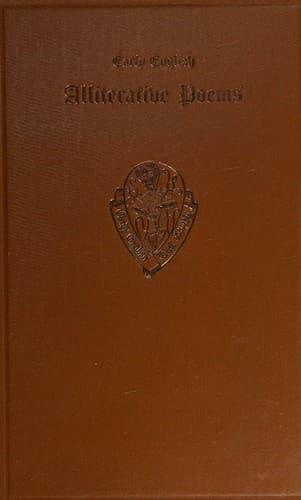
Early English Alliterative Poems: in the West-Midland Dialect of the Fourteenth Century
Religion
Early English Alliterative Poems: in the West-Midland Dialect of the Fourteenth Century
English poetry -- Middle English, 1100-1500
He shall be the third lord in the realm.
As soon as this cry was upcast, to the hall came clerks out of Chaldea,
witches and diviners, sorcerers and exorcists.
But after looking on the letters they were as ignorant as if they had
looked into the leather of the left boot.
The king curses them all and calls them churls.
He orders the harlots to be hanged.
The queen hears the king chide.
She inquires the cause.
Goes to the king, kneels before him, and asks why he has rent his robes
for grief, when there is one that has the Spirit of God, the counsellor
of Nebuchadnezzar, the interpreter of his dreams, through the holy
Spirit of God.
The name of this man is Daniel, who was brought a captive from Judæa.
The queen tells the king to send for Daniel.
Her counsel is accepted.
Daniel comes before Belshazzar.
The king tells him that he has heard of his wisdom, and his power to
discover hidden things, and that he wants to know the meaning of the
writing on the wall.
Promises him, if he can explain the text of the letters and their
interpretation, to clothe him in purple and pall, and put a ring about
his neck, and to make him “a baron upon bench.”
Daniel addresses the king, and reminds him how that God supported his
father, and gave him power to exalt or abase whomsoever he pleased.
Nebuchadnezzar was established on account of his faith in God.
So long as he remained true, no man was greater.
But at last pride touches his heart.
He forgets the power of God, and blasphemes His name.
He says that he is “god of the ground,” and the builder of Babylon.
Hardly had Nebuchadnezzar spoken, when God’s voice is heard, saying,
“Thy principality is departed.
Thou, removed from men, must abide on the moor, and walk with wild
beasts, eat herbs, and dwell with wolves and asses.”
For his pride he becomes an outcast.
He believes himself to be a bull or an ox.
Goes “on all fours,” like a cow, for seven summers.
His thighs grew thick.
His hair became matted and thick, from the shoulders to the toes.
His beard touched the earth.
His brows were like briars.
His eyes were hollow, and grey as the kite’s.
Eagle-hued he was.
At last he recovered his “wit,” and believed in God.
Then soon was he restored to his seat.
But thou, Belshazzar, hast disregarded these signs, and hast blasphemed
the Lord, defiled his vessels, filling them with wine for thy wenches,
and praising thy lifeless gods.
For this sin God has sent thee this strange sight, the fist with the
fingers writing on the wall.
These are the words: “Mene, Tekel, Peres.
Mene.-- God has counted thy kingdom and finished it.
Tekel.-- Thy reign is weighed and is found wanting in deeds of faith.
Peres.-- Thy kingdom is divided, and given to the Persians.
The Medes shall be masters here.”
The king commands Daniel to be clothed in a frock of fine cloth.
Soon is he arrayed in purple, with a chain about his neck.
A decree is made, that all should bow to him, as the third lord that
followed Belshazzar.
Public-domain text, read in full here on John Shaqi.
Reviews
Reviews
No reviews yet
Be the first to share your thoughts on this work.
Elsewhere in the archive
Join the Discussion
Join the discussion
Sign in to leave a comment or review.
Sign InorCreate an account