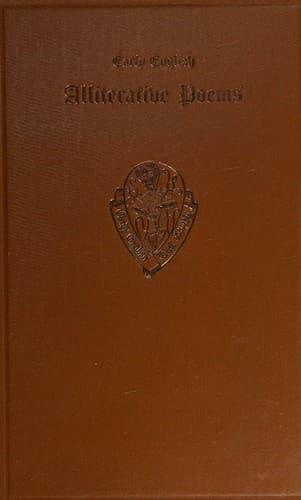
Early English Alliterative Poems: in the West-Midland Dialect of the Fourteenth Century
Religion
Early English Alliterative Poems: in the West-Midland Dialect of the Fourteenth Century
English poetry -- Middle English, 1100-1500
The participle passive or perfect of regular verbs terminates in _-ed_;
of irregular verbs in _-en_. Occasionally we find the _n_ disappearing,
as _bigonn-e_, _fund-e_, _runn-e_, _wonn-e_, where perhaps it is
represented by the final _-e_.
The prefix _-i_ or _-y_ (A.S. _-ge_) occurs twice only in the poems, in
_i-chose_ (chosen), and _i-brad_ (extended); but, while common enough in
the Southern and Midland dialects, it seems to be wholly unknown to the
Northumbrian speech.
The verb in the West-Midland dialect is conjugated according to the
following model:--
I.--+Conjugation of Regular Verbs.+
INDICATIVE MOOD.
PRESENT TENSE.
Singular. Plural.
(I) hope, (We) hopen.
(Thou) hopes, (Ȝe) hopen.
(He) hopes, (Thay) hopen.
PRETERITE TENSE.
(I) hopede[64] (hoped), (We) hopeden.
(Thou) hopedes (hoped), (Ȝe) hopeden.
(He) hopede[64] (hoped), (Thay) hopeden.
IMPERATIVE MOOD.
Hope (thou). Hopes (ȝe).
PARTICIPLES.
Imperfect or Active. Perfect or Passive.
Hopande. Hoped.
II.--+Conjugation of Irregular Verbs.+
INDICATIVE MOOD.
PRESENT TENSE.
Singular.
(I) kerve, renne, smite, stonde.
(Thou) kerves, rennes, smites, stondes.
(He) kerves, rennes, smites, stondes.
Plural.
(We) kerven, rennen, smiten, stonden.
(Ȝe) „ „ „ „
(Thay) „ „ „ „
PRETERITE TENSE.
Singular.
(I) carf, ran, smot, stod.
(Thou) carve, ranne, smote, stode.
(He) carf, ran, smot, stod.
Very frequently the _e_ in the second person is dropped,[65] as in the
Northumbrian dialect, but we never meet with such forms as carves
(= carvedest), rannes (= ranst), smotes (= smotest), etc.
Plural.
(We) corven, runnen, smiten, stonden.
(Ȝe) „ „ „ „
(Thay) „ „ „ „
PASSIVE PARTICIPLES.
Corven, runnen, smiten, stonden.
The Northumbrian dialect does not preserve any separate form for the
preterite plural, and this distinction is not always observed in the
present poems.
+Table of Verbs.+
A.--SIMPLE ORDER.
Present. Preterite. Passive Participle.
Class I.
Hate, hatede, hated.
Public-domain text, read in full here on John Shaqi.
Reviews
Reviews
No reviews yet
Be the first to share your thoughts on this work.
Join the Discussion
Join the discussion
Sign in to leave a comment or review.
Sign InorCreate an account