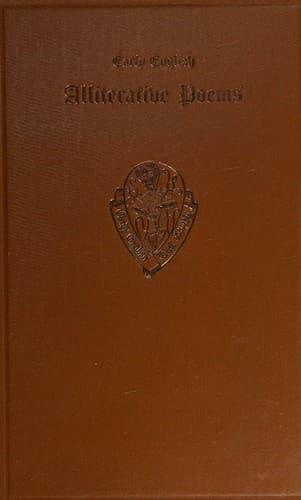
Early English Alliterative Poems: in the West-Midland Dialect of the Fourteenth Century
Religion
Early English Alliterative Poems: in the West-Midland Dialect of the Fourteenth Century
English poetry -- Middle English, 1100-1500
[Sidenote: [Fol. 42b.]]
[Sidenote: The maiden tells him that his pearl is not really
lost. She is in a garden of delight, where sin and mourning
are unknown.]
That Iuel þe{n}ne in ge{m}myȝ gente,
Vered vp her vyse w{i}t{h} yȝen graye,
Set on hyr corou{n} of perle orie{n}t,
& soberly after þe{n}ne con ho say: 256
“Si{r} ȝe haf yo{ur} tale myse-tente,
To say yo{ur} perle is al awaye,
Þat is i{n} cofer, so comly clente,
As i{n} þis gardyn gracios gaye, 260
Here-i{n}ne to lenge for eu{er} & play.
Þer mys nee morny{n}g com neu{er} here,
Her were a forser for þe i{n} faye,
If þ{o}u were a gentyl Iueler. 264
[Headnote: SHE TELLS HIM OF HER BLISS.]
[Sidenote: The rose that he had lost is become a pearl of price.
The pearl blames his rash speech.]
Bot Iueler gente if þ{o}u schal lose
Þy ioy for a ge{m}me þat þe watȝ lef,
Me þynk þe put i{n} a mad porpose,
& busyeȝ[9] þe aboute a raysou{n} bref, 268
For þat þ{o}u lesteȝ watȝ bot a rose,
Þat flowred & fayled as kynde hyt gef;
Now þurȝ kynde of þe kyste þ{a}t hyt con close,
To a perle of prys hit is put i{n} pref; 272
& þ{o}u hatȝ called þy wyrde a þef,
Þat oȝt of noȝt hatȝ mad þe cler;
Þ{o}u blameȝ þe bote of þy meschef,
Þ{o}u art no kynde Iueler.” 276
[Sidenote 9: Looks like _husyeȝ_ in MS.]
[Sidenote: The father begs the maiden to excuse his speech, for
he really thought his pearl was wholly lost to him.]
A Iuel to me þen watȝ þys geste,
& iueleȝ wern hyr ge{n}tyl saweȝ,
“I-wyse,” q{uod} I, “my blysfol beste,
My grete dystresse þ{o}u al to-draweȝ, 280
To be excused I make requeste;
I trawed my perle don out of daweȝ,
Now haf I fonde hyt I schal ma feste,
& wony w{i}t{h} hyt i{n} schyr wod schaweȝ, 284
& loue my lorde & al his laweȝ,
Þat hatȝ me broȝ[t] þys blys ner;
Now were I at yow by-ȝonde þise waweȝ,
I were a ioyfol Iueler.” 288
[Sidenote: [Fol. 43a.]]
[Sidenote: The maiden tells her father that he has spoken
three words without knowing the meaning of one. The first word.
The second. The third.]
“Iueler,” sayde þat ge{m}me clene,
“Wy borde ȝe men, so madde ȝe be?
Þre wordeȝ hatȝ þ{o}u spoken at ene,
Vn-avysed, for soþe, wern alle þre, 292
Þou ne woste in worlde quat on dotȝ mene,
Þy worde byfore þy wytte con fle.
Þou says þ{o}u traweȝ me i{n} þis dene,
By cawse þ{o}u may w{i}t{h} yȝen me se; 296
Anoþ{er} þ{o}u says, i{n} þys cou{n}tre
Þy self schal won w{i}t{h} me ryȝt here;
Þe þrydde, to passe þys wat{er} fre,
Þat may no ioyfol Iueler. 300
Public-domain text, read in full here on John Shaqi.
Reviews
Reviews
No reviews yet
Be the first to share your thoughts on this work.
Join the Discussion
Join the discussion
Sign in to leave a comment or review.
Sign InorCreate an account