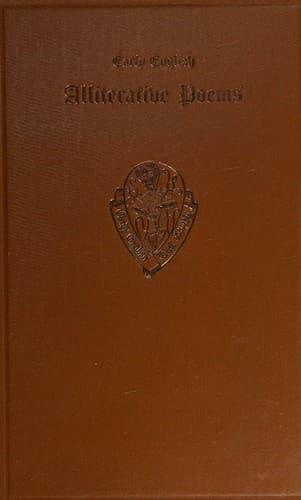
Early English Alliterative Poems: in the West-Midland Dialect of the Fourteenth Century
Religion
Early English Alliterative Poems: in the West-Midland Dialect of the Fourteenth Century
English poetry -- Middle English, 1100-1500
[Sidenote: Those invited begin to make excuses.]
When þay knewen his cal þ{a}t þider com schulde,
Alle ex-cused hem by þe skyly he scape by moȝt:
[Sidenote: One had bought an estate and must go to see it.]
On hade boȝt hym a borȝ he sayde by hys t{ra}wþe,
Now t[ur]ne I þeder als tyd, þe tou{n} to by-holde; 64
[Sidenote: Another had purchased some oxen and wished to see
them “pull in the plough.”]
An oþ{er} nayed also & nurned þis cawse:
I haf ȝerned & ȝat ȝokkeȝ of oxen,
& for my hyȝeȝ hem boȝt, to bowe haf I mest{er},
To see hem pulle in þe plow aproche me byhoueȝ; 68
[A third had married a wife and could not come.]
& I haf wedded a wyf, sower[3] hy{m} þe þryd,
Excuse me at þe co{ur}t, I may not com þere;
Þ{us} þay droȝ hem adreȝ w{i}t{h} dau{n}g{er} vchone,
Þat non passed to þe place[4] þaȝ he prayed were. 72
[Sidenote: [Fol. 58a.]]
[Sidenote: The Lord was greatly displeased, and commanded his
servants to invite the wayfaring, both men and women, the better
and the worse, that his palace might be full.]
The{n}ne þe ludych lorde lyked ful ille
& hade dedayn of þat dede, ful dryȝly he carpeȝ:
He saytȝ “now for her owne sorȝe þay for-saken habbeȝ,
More to wyte is her wrange, þen any wylle gentyl; 76
Þe{n}ne gotȝ forth my gomeȝ to þe grete streeteȝ,
& forsetteȝ on vche a syde þe cete aboute;
Þe wayferande frekeȝ, on fote & on hors,
Boþe burneȝ & burdeȝ, þe bett{er} & þe wers, 80
Laþeȝ hem alle luflyly to lenge at my fest,
& bry{n}geȝ hem blyþly to borȝe as barou{n}eȝ þay were,
So þat my palays plat-ful be pyȝt al aboute,
Þise oþ{er} wrecheȝ I-wysse worþy noȝt wern.” 84
[Sidenote: The servants brought in bachelors and squires.]
Þe{n} þay cayred & com þat þe cost waked,
Broȝten bachlereȝ hem wyth þat þay by bonkeȝ metten,
Swyereȝ þat swyftly swyed on blonkeȝ,
& also fele vpon fote, of fre & of bonde. 88
[Sidenote: When they came to the court they were well
entertained.]
When þay com to þe co{ur}te keppte wern þay fayre,
Styȝtled w{i}t{h} þe stewarde, stad i{n} þe halle,
Ful man{er}ly w{i}t{h} marchal mad forto sitte,
As he watȝ dere of de-gre dressed his seete. 92
[Sidenote: The servants tell their lord that they have done his
behest, and there is still room for more guests.]
Þe{n}ne seggeȝ to þe souerayn sayden þer-aft{er},
“Lo! lorde w{i}t{h} yo{ur} leue at yo{ur} lege heste,
& at þi ba{n}ne we haf broȝt, as þ{o}u beden habbeȝ,
Mony renischche renkeȝ & ȝet is rou{m} more.” 96
[Headnote: THE HALT AND THE BLIND ARE INVITED.]
Public-domain text, read in full here on John Shaqi.
Reviews
Reviews
No reviews yet
Be the first to share your thoughts on this work.
Elsewhere in the archive
Join the Discussion
Join the discussion
Sign in to leave a comment or review.
Sign InorCreate an account