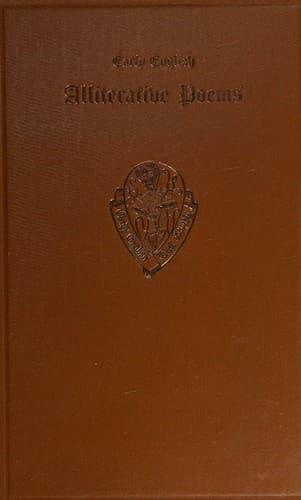
Early English Alliterative Poems: in the West-Midland Dialect of the Fourteenth Century
Religion
Early English Alliterative Poems: in the West-Midland Dialect of the Fourteenth Century
English poetry -- Middle English, 1100-1500
[Sidenote: The Lord commands them to go out into the fields, and
bring in the halt, blind, and “one-eyed.”]
Sayde þe lorde to þo ledeȝ, “layteȝ ȝet ferre,
Ferre out i{n} þe felde, & fecheȝ mo gesteȝ,
Wayteȝ gorsteȝ & greueȝ, if ani gomeȝ lyggeȝ,
What-kyn folk so þer fare, fecheȝ hem hider, 100
Be þay fers, be þay feble for-loteȝ[5] none,
Be þay hol, be þay halt, be þay onyȝed,
& þaȝ þay ben boþe blynde & balt{er}ande cruppeleȝ,
[Sidenote: For those who denied shall not taste “one sup” to
save them from death.]
Þat my ho{us} may holly by halkes by fylled; 104
For certeȝ þyse ilk renkeȝ þat me renayed habbe
& de-nou{n}ced me, noȝt now at þis tyme,
Schul neu{er} sitte in my sale my sop{er} to fele,
Ne suppe on sope of my seve, þaȝ[6] þay swelt schulde.” 108
[Sidenote: [Fol. 58b.]]
[Sidenote: The palace soon became full of “people of all
plights.”]
The{n}ne þe sergau{n}teȝ, at þat sawe, swengen þ{er}-oute,
& diden þe dede þat [is] demed, as he deuised hade,
& w{i}t{h} peple of alle plyteȝ þe palays þay fyllen;
[Sidenote: They were not all one wife’s sons, nor had they all
one father.]
Hit weren not alle on wyueȝ su{n}eȝ, wonen w{i}t{h} on fader; 112
Wheþ{er} þay wern worþy, oþ{er} wers, wel wern þay stowed,
[Sidenote: The “brightest attired” had the best place.]
Ay þe best byfore & bryȝtest atyred,
Þe derrest at þe hyȝe dese þat dubbed wer fayrest;
[Sidenote: Below sat those with “poor weeds.”]
& syþen on lenþe biloogh{e} ledeȝ inogh, 116
& ay a segge soerly[7] semed by her wedeȝ;
So with marschal at her mete mensked þay were,
Clene men i{n} compaynye for-knowen wern lyte,
[Sidenote: All are well entertained “with meat and minstrelsy.”]
& ȝet þe symplest in þ{a}t sale watȝ serued to þe fulle, 120
Boþe with menske, & w{i}t{h} mete & mynstrasy noble,
& alle þe laykeȝ þat a lorde aȝt i{n} londe schewe.
[Sidenote: Each with his “mate” made him at ease.]
& þay bigo{n}ne to be glad þat god dri{n}k haden,
& vch mon w{i}t{h} his mach made hy{m} at ese. 124
[Sidenote 1: _aywhere_ (?).]
[Sidenote 2: Looks like _burre_ in MS.]
[Sidenote 3: _swer_ (?).]
[Sidenote 4: MS. _plate_.]
[Sidenote 5: _forleteȝ_ (?).]
[Sidenote 6: MS. þaȝ þaȝ.]
[Sidenote 7: _soberly_ (?).]
[Headnote: THE MAN WITHOUT A WEDDING GARMENT.]
II.
Public-domain text, read in full here on John Shaqi.
Reviews
Reviews
No reviews yet
Be the first to share your thoughts on this work.
Elsewhere in the archive
Join the Discussion
Join the discussion
Sign in to leave a comment or review.
Sign InorCreate an account