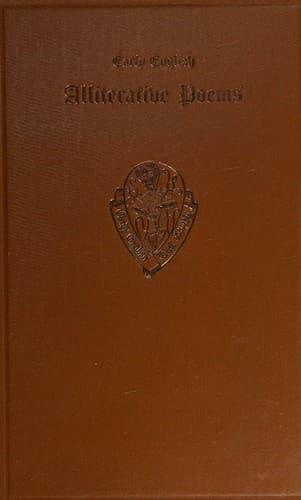
Early English Alliterative Poems: in the West-Midland Dialect of the Fourteenth Century
Religion
Early English Alliterative Poems: in the West-Midland Dialect of the Fourteenth Century
English poetry -- Middle English, 1100-1500
[Footnote 6: The peculiarities referred to do not appear to be
owing to the copyist of the Lincoln manuscript (Robert de
Thornton, a native of Oswaldkirk in Yorkshire), who, being a
Northumbrian, would probably have restored the original readings.
The non-Northumbrian forms in the Morte Arthure are-- 1. The
change of _a_ into _o_, as _bolde_ for _balde_, _bote_ for _bate_,
_one_ for _ane_, _honde_ for _hande_, _londe_ for _lande_;
2. _they_, _theyre_, _them_, _theym_, for _thay_, _thaire_,
_tham_; 3. _gayliche_, _kindliche_, _semlyche_, etc., for _gayly_,
_kindly_, _seemly_, etc. (the termination _lich_, _liche_, was
wholly unknown to the Northumbrian dialect, being represented by
_ly_ or _like_); 4. _churle_, _churche_, _iche_, _mache_, _myche_,
_syche_, _wyrche_, etc., for _carle_, _kirke_, _ilk_, _make_,
_mykelle_, _swilk_, _wyrk_, etc.; 5. infinitives in _-en_, as
_drenschen_, _schewenne_, _wacchenne_, etc.; 6. the use of _eke_,
_thos_, for _als_ (_alswa_), _thas_; 7. the employment of _aye_
for _egg_. The former word _never_ occurs in any pure Northumbrian
work, while the latter is seldom met with in any Southern
production.]
[Footnote 7: The poems are _Northern_ in contradistinction to
_Southern_, but they are not Northern or Northumbrian in
contradistinction to _Midland_.]
[Footnote 8: Printed by Mr. D. Laing in his “Inedited Pieces,”
from a MS. of Mr. Heber’s. Other copies are in the Vernon MS., and
Cotton Calig. A. ii.; the latter imperfect.]
[Footnote 9: Other specimens of this dialect will doubtless turn
up. Mr. Brock has found a MS. in British Museum (Harl. 3909) with
most of the peculiarities pointed out by me in the preface to the
present work, and I believe that this dialect was probably a
flourishing one in the 13th century. See O.E. Homilies, p. li.]
[Footnote 10: (1) _en_ as the inflexion of the pres. tense pl.,
indic. mood of verbs; (2) _s_ in the second and third pers. sing.
of verbs; (3) _ho_ = she; (4) _hit_ = its; (5) _tow_ = two;
(6) _deȝter_ = daughters, etc.]
[Footnote 11: See p. 36, ll. 1052-1066; p. 37, ll. 1074-1089; pp.
161-162, ll. 4956-4975.]
[Footnote 12: See pp. 25, 26 (Jason’s unfaithfulness); pp. 74, 75,
ll. 2241-2255; p. 75, ll. 2256-2263; p. 69, ll. 2267-2081; p. 158,
ll. 4839-4850; p. 189, ll. 4881-4885; p. 165, ll. 5078-5086, etc.]
[Footnote 13: In the Harl. MS. 3909, nearly all the p. part. and
preterites end in _-et_ (_-ut_ and _-et_ occur in Romances ed. by
Robson).]
[Footnote 14: This seems to furnish an etymology for _Clent_
Hills, Worcestershire--_brent_ is the term employed in
Alliterative.]
Public-domain text, read in full here on John Shaqi.
Reviews
Reviews
No reviews yet
Be the first to share your thoughts on this work.
Join the Discussion
Join the discussion
Sign in to leave a comment or review.
Sign InorCreate an account