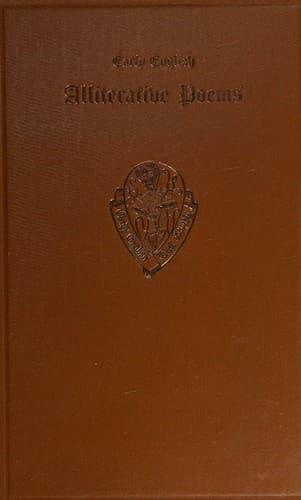
Early English Alliterative Poems: in the West-Midland Dialect of the Fourteenth Century
Religion
Early English Alliterative Poems: in the West-Midland Dialect of the Fourteenth Century
English poetry -- Middle English, 1100-1500
[Sidenote: For the fault of one, vengeance alighted upon all men.]
Bot þat oþ{er} wrake þat wex on wyȝeȝ, hit lyȝt
Þurȝ þe faut of a freke þat fayled i{n} trawþe. 236
[Sidenote: Adam was ordained to live in bliss.]
A{da}m i{n} obedyent[14] ordaynt to blysse,
Þer pryuely i{n} paradys his place watȝ de-vised,
To lyue þer i{n} lyky{n}g þe lenþe of a terme,
& þe{n}ne en-herite þat home þat au{n}geleȝ for-gart, 240
[Sidenote: Through Eve he ate an apple.]
Bot þurȝ þe eggy{n}g of eue he ete of an apple
Þat en-poysened alle pepleȝ þat parted fro hem boþe,
[Sidenote: Thus all his descendants became poisoned.]
For a defence þat watȝ dyȝt of dryȝtyn seluen,
& a payne þer-on put & pertly halden; 244
Þe defence watȝ þe fryt þat þe freke towched,
& þe dom is þe deþe þat drepeȝ v{us} alle.
[Sidenote: A maiden brought a remedy for mankind.]
Al i{n} mesure & meþe watȝ mad þe vengiau{n}ce,
& efte amended w{i}t{h} a mayden þat make hade neu{er}. 248
[Sidenote 11: _wened_ (?).]
[Sidenote 12: _ȝis_ (?).]
[Sidenote 13: MS. _lyttlel_.]
[Sidenote 14: _obedience_ (?).]
[Headnote: THE WICKEDNESS OF THE ANTEDILUVIAN WORLD.]
IV.
Bot in þe þryd watȝ forþrast al þat þryue schuld,
[Sidenote: Malice was merciless.]
Þer watȝ malys mercyles & mawgre much scheued,
Þat watȝ for fylþe vpon folde þ{a}t þe folk vsed,
[Sidenote: A race of men came into the world, the fairest, the
merriest, and the strongest that ever were created.]
[Þ]at þen wonyed i{n} þe worlde w{i}t{h}-outen any mayst{er}ȝ; 252
[Sidenote: [Fol. 60b.]]
Hit wern þe fayrest of forme & of face als,
Þe most & þe myriest þat maked wern euer,
Þe styfest, þe stalworþest þat stod eu{er} on fete;
& lengest lyf i{n} hem lent of ledeȝ alle oþ{er}, 256
For hit was þe forme-foster þat þe folde bred,
[Sidenote: They were sons of Adam.]
Þe aþel au{n}cetereȝ su{n}eȝ þat ad{a}m watȝ called,
To wham god hade geuen alle þat gayn were,
Alle þe blysse boute blame þat bodi myȝt haue, 260
& þose lykkest to þe lede þat lyued next aft{er},
For-þy so semly to see syþe{n} wern none.
[Sidenote: No law was laid upon them.]
Þer watȝ no law to hem layd bot loke to kynde,
& kepe to hit, & alle hit cors clanly ful-fylle; 264
[Sidenote: Nevertheless they acted unnaturally.]
& þe{n}ne fou{n}den þay fylþe i{n} fleschlych dedeȝ
& controeued agayn kynde contraré werkeȝ,
& vsed hem vn-þryftyly vchon on oþ{er},
& als with oþ{er}, wylsfully, vpon a wrange wyse. 268
[Sidenote: The “_fiends_” beheld how fair were the daughters of
these mighty men, and made fellowship with them and begat a race
of giants.]
So ferly fowled her flesch þat þe fende loked,
How þe deȝt{er} of þe douþe wern dere-lych fayre,
& fallen i{n} felaȝschyp w{i}t{h} hem on folken wyse
Public-domain text, read in full here on John Shaqi.
Reviews
Reviews
No reviews yet
Be the first to share your thoughts on this work.
Elsewhere in the archive
Join the Discussion
Join the discussion
Sign in to leave a comment or review.
Sign InorCreate an account