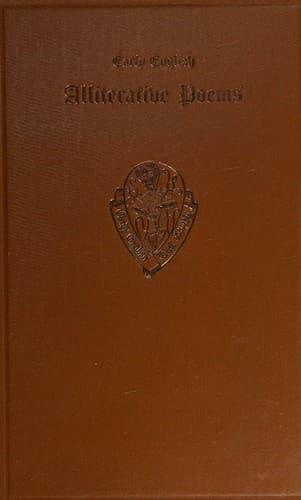
Early English Alliterative Poems: in the West-Midland Dialect of the Fourteenth Century
Religion
Early English Alliterative Poems: in the West-Midland Dialect of the Fourteenth Century
English poetry -- Middle English, 1100-1500
& en-gendered on hem ieau{n}teȝ w{i}t{h} her Iapeȝ ille. 272
Þose wern men meþeleȝ & maȝty on vrþe,
Þat for her lodlych laykeȝ alosed þay were.
He watȝ famed[15] for fre þat feȝt loued best,
[Sidenote: The greatest fighter was reckoned the most famous.]
& ay þe bigest i{n} bale þe best watȝ halden; 276
& þe{n}ne eueleȝ on erþe ernestly grewen
& multyplyed mony-folde i{n}-mongeȝ mankynde,
[Sidenote: The Creater of all becomes exceedingly wroth.]
For þat þe maȝty on molde so marre þise oþ{er}.
Þat þe wyȝe þat al wroȝt ful wroþly bygy{n}neȝ. 280
[Headnote: GOD DETERMINES TO DESTROY ALL FLESH.]
When he knew vche contre corupte i{n} hit seluen,
& vch freke forloyned fro þe ryȝt wayeȝ,
[Sidenote: Fell anger touches His heart.]
Felle temptande tene towched his hert;
As wyȝe, wo hy{m} with-i{n}ne werp to hy{m} seluen: 284
[Sidenote: It repents Him that He has made man.]
“Me for-þy{n}keȝ ful much þat eu{er} I mon made,
Bot I schal delyu{er} & do away þat doten on þis molde,
[Sidenote: He declares that all flesh shall be destroyed, both
man and beast.]
& fleme out of þe folde al þat flesch wereȝ,
Fro þe burne to þe best, fro bryddeȝ to fyscheȝ; 288
[Sidenote: [Fol. 61a.]]
Al schal dou{n} & be ded & dryuen out of erþe,
Þat eu{er} I sette saule i{n}ne; & sore hit me rweȝ
Þat eu{er} I made hem my self; bot if I may her-aft{er},
I schal wayte to be war her wrencheȝ to kepe.” 292
[Sidenote: There was at this time living on the earth a very
righteous man: Noah was his name.]
Þe{n}ne i{n} worlde watȝ a wyȝe wonyande on lyue,
Ful redy & ful ryȝtwys, & rewled hy{m} fayre;
In þe drede of dryȝtyn his dayeȝ he vseȝ,
& ay glydande wyth his god his g{ra}ce watȝ þe more. 296
Hy{m} watȝ þe nome Noe, as is i{n}noghe knawen,
[Sidenote: Three bold sons he had.]
He had þre þryuen su{n}eȝ & þay þre wyueȝ;
Sem soþly þat on, þat oþ{er} hyȝt cam
& þe Iolef Iapheth watȝ gendered þe þryd. 300
[Sidenote: God in great anger speaks to Noah.]
Now god i{n} nwy to Noe co{n} speke,
Wylde wrakful wordeȝ i{n} his wylle greued:
“Þe ende of alle-kyneȝ flesch þat on vrþe meueȝ,
Is fallen forþ wyth my face & forþ{er} hit I þenk, 304
W{i}t{h} her vn-worþelych werk me wlateȝ w{i}t{h}-i{n}ne,
Þe gore þ{er}-of me hatȝ greued & þe glette nwyed;
[Sidenote: Declares that He will destroy all “that life has.”]
I schal strenkle my distresse & strye al to-geder,
Boþe ledeȝ & londe & alle þat lyf habbeȝ. 308
[Headnote: NOAH IS COMMANDED TO BUILD AN ARK.]
Public-domain text, read in full here on John Shaqi.
Reviews
Reviews
No reviews yet
Be the first to share your thoughts on this work.
Elsewhere in the archive
Join the Discussion
Join the discussion
Sign in to leave a comment or review.
Sign InorCreate an account