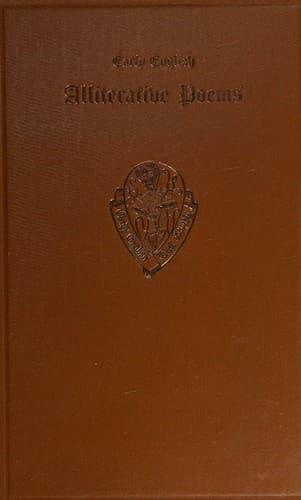
Early English Alliterative Poems: in the West-Midland Dialect of the Fourteenth Century
Religion
Early English Alliterative Poems: in the West-Midland Dialect of the Fourteenth Century
English poetry -- Middle English, 1100-1500
[Sidenote: God asks Noah whether all is ready.]
“Now Noe,” q{uod} oure lorde, “art þ{o}u al redy?
Hatȝ þ{o}u closed þy kyst w{i}t{h} clay alle aboute?”
[Sidenote: Noah replies that all is fully prepared.]
“Ȝe lorde w{i}t{h} þy leue,” sayde þe lede þe{n}ne,
“Al is wroȝt at þi worde, as þ{o}u me wyt lanteȝ.” 348
[Sidenote: He is commanded to enter the ark, for God tells him
that he will send a rain to destroy all flesh.]
“Enter in þe{n}n,” q{uod} he, “& haf þi wyf w{i}t{h} þe,
Þy þre su{n}eȝ w{i}t{h}-outen þrep & her þre wyueȝ;
Besteȝ, as I bedene haue, bosk þ{er}-i{n}ne als,
& when ȝe arn staued, styfly stekeȝ yow þ{er}i{n}ne; 352
Fro seuen dayeȝ ben seyed I sende out by-lyue,
Such a rowtande ryge þat rayne schal swyþe,
Þat schal wasch alle þe worlde of werkeȝ of fylþe;
Schal no flesch vpon folde by fonden onlyue; 356
[Sidenote: Noah stows all safely in the ark.]
Out-taken yow aȝt i{n} þis ark staued,
& sed þat I wyl saue of þyse ser besteȝ.”
Now Noe neu{er} stysteȝ[17] (þat niyȝ[t] he bygy{n}neȝ),
Er al wer stawed & stoken, as þe steuen wolde. 360
[Sidenote: [Fol. 62a.]]
[Sidenote: Seven days are passed.]
The{n}ne sone com þe seuenþe day, when samned wern alle,
& alle woned i{n} þe whichche þe wylde & þe tame.
[Sidenote: The deep begins to swell, banks are broken down, and
the clouds burst.]
Þe{n} bolned þe abyme & bonkeȝ con ryse,
Walt{es} out vch walle-heued, i{n} ful wode stremeȝ, 364
Watȝ no bry{m}me þat abod vnbrosten bylyue,
Þe mukel lauande logh{e} to þe lyfte rered.
Mony clust{er}ed clowde clef alle i{n} clowteȝ,
To-rent vch a rayn-ryfte & rusched to þe vrþe; 368
[Sidenote: It rains for forty days, and the flood rises, and
flows over the woods and fields.]
Fon neu{er} i{n} forty dayeȝ, & þe{n} þe flod ryses,
Ou{er}-walteȝ vche a wod & þe wyde feldeȝ;
For when þe wat{er} of þe welkyn w{i}t{h} þe worlde mette,
Alle þat deth moȝt dryȝe drowned þer-i{n}ne; 372
Þer watȝ moon forto make when meschef was cnowen,
[Sidenote: All must drown.]
Þat noȝt dowed bot þe deth in þe depe stremeȝ.
Wat{er} wylger ay wax, woneȝ þat stryede,
Hurled i{n}-to vch ho{us}, hent þat þer dowelled. 376
[Sidenote: The water enters the houses.]
Fyrst feng to þe flyȝt alle þat fle myȝt,
Vuche burde w{i}t{h} her barne þe byggy{n}g þay leueȝ,
[Sidenote: Each woman with her bairns flees to the hills.]
& bowed to þe hyȝ bonk þer brentest hit wern,
& het{er}ly to þe hyȝe hylleȝ þay [h]aled on faste; 380
[Sidenote: The rain never ceases.]
Bot al watȝ nedleȝ her note, for neu{er} cowþe stynt
Þe roȝe raynande ryg [&] þe raykande waweȝ,
[Sidenote: The valleys are filled.]
Er vch boþom watȝ brurd-ful to þe bonkeȝ eggeȝ,
& vche a dale so depe þat de{m}med at þe brynkeȝ.
Public-domain text, read in full here on John Shaqi.
Reviews
Reviews
No reviews yet
Be the first to share your thoughts on this work.
Elsewhere in the archive
Join the Discussion
Join the discussion
Sign in to leave a comment or review.
Sign InorCreate an account