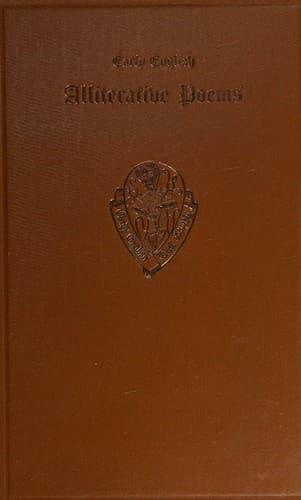
Early English Alliterative Poems: in the West-Midland Dialect of the Fourteenth Century
Religion
Early English Alliterative Poems: in the West-Midland Dialect of the Fourteenth Century
English poetry -- Middle English, 1100-1500
The maiden rises, and, proceeding along the bank of the stream,
approaches him. He tells her that he has done nothing but mourn for the
loss of his Pearl, and has been indeed a “joyless jeweller” (p. 8).
However, now that he has found his Pearl, he declares that he is no
longer sorrowful, but would be a “joyful jeweller” were he allowed to
cross the stream (p. 8). The maiden blames her father for his rash
speech, tells him that his Pearl is not lost, and that he cannot pass
the stream till after death (p. 10). The dreamer is in great grief; he
does not, he says, care what may happen if he is again to lose his
Pearl. The maiden advises him to bear his loss patiently, and to abide
God’s doom (p. 11). She describes to him her blissful state in heaven,
where she reigns as a queen (p. 12). She explains to him that Mary is
the Empress of Heaven, and all others kings and queens (p. 13). The
parable of the labourers in the vineyard[15] (pp. 15-18) is then
rehearsed at length, to prove that “innocents” are admitted to the same
privileges as are enjoyed by those who have lived longer upon the earth
(p. 18). The maiden then speaks to her father of Christ and his one
hundred and forty thousand brides (p. 24), and describes their blissful
state (p. 26). She points out to him the heavenly Jerusalem, which was
“all of bright burnished gold, gleaming like glass” (p. 29). Then the
dreamer beholds a procession of virgins going to salute the Lamb, among
whom he perceives his “little queen” (p. 33). On attempting to cross the
stream to follow her, he is aroused from his dream (p. 35), laments his
rash curiosity in seeking to know so much of God’s mysteries, and
declares that man ever desires more happiness than he has any right to
expect (p. 35).
[Footnote 15: Matthew, chapter xx.]
The second poem, entitled “_Cleanness_,” is a collection of Biblical
stories, in which the writer endeavours to enforce Purity of Life, by
showing how greatly God is displeased at every kind of impurity, and how
sudden and severe is the punishment which falls upon the sinner for
every violation of the Divine law.
After commending cleanness and its “fair forms,” the author relates (I.)
The Parable of the Marriage Feast (p. 39); (II.) the Fall of the Angels
(p. 43); (III.) The wickedness of the antediluvian world (p. 44),
He watȝ famed for fre þat feȝt loued best
_He was famous as free that fight loved best,_
& ay þe bigest in bale þe best watȝ halden
_And ever the biggest in sin the best was held;_ (p. 45.)
(IV.) The destruction of mankind by the Flood. When all were safely
stowed in the ark,
Public-domain text, read in full here on John Shaqi.
Reviews
Reviews
No reviews yet
Be the first to share your thoughts on this work.
Join the Discussion
Join the discussion
Sign in to leave a comment or review.
Sign InorCreate an account