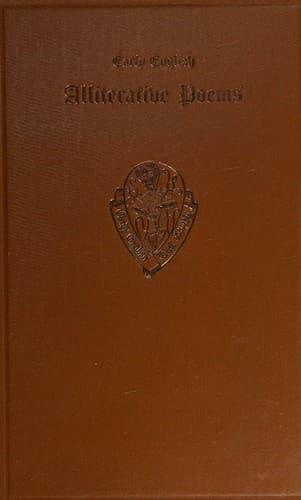
Early English Alliterative Poems: in the West-Midland Dialect of the Fourteenth Century
Religion
Early English Alliterative Poems: in the West-Midland Dialect of the Fourteenth Century
English poetry -- Middle English, 1100-1500
[Sidenote: A sea now occupies the place of the four cities.]
Þer faur{e} citees wern set, nov is a see called,
Þat ay is drouy & dym, & ded i{n} hit kynde, 1016
Blo, blubrande, & blak, vnblyþe to neȝe,
[Sidenote: It is a stinking pool, and is called the Dead Sea.]
As a stynkande stanc þat stryed sy{n}ne,
Þat eu{er} of sy{n}ne & of smach, smart is to fele;
For-þy þe derk dede see hit is demed eu{er} more, 1020
For hit dedeȝ of deþe duren þere ȝet.
For hit is brod & boþe{m}leȝ, & bitter as þe galle,
[Sidenote: Nothing may live in it.]
& noȝt may lenge i{n} þat lake þat any lyf bereȝ,
& alle þe costeȝ of kynde hit combreȝ vchone; 1024
[Sidenote: Lead floats on its surface.]
For lay þ{er}-on a lump of led & hit on loft fleteȝ,
[Sidenote: A feather sinks to the bottom of it.]
& folde þ{er}-on a lyȝt fyþ{er} & hit to fou{n}s synkkeȝ.
[Sidenote: Lands, watered by this sea, never bear grass or weed.]
& þ{er} wat{er} may walt{er} to wete any erþe,
Schal neu{er} grene þ{er}-on growe, gresse ne wod nawþ{er}. 1028
If any schalke to be schent wer schowued þ{er}-i{n}ne,
Þaȝ he bode i{n} þat boþe{m} broþely a monyth,
[Sidenote: A man cannot be drowned in it.]
He most ay lyue i{n} þat loȝe i{n} losy{n}g eu{er}-more,
& neu{er} dryȝe no dethe, to dayes of ende; 1032
& as hit is corsed of kynde & hit coosteȝ als,
[Sidenote: The clay clinging to it is corrosive, as alum,
alkaran, sulphur, etc., which fret the flesh and fester the
bones.]
Þe clay þat clenges þ{er}-by arn corsyes strong,
As alu{m} & alkaran,[50] þat angré[51] arn boþe,
Soufre so{ur}, & sau{n}dyu{er}, & oþ{er} such mony; 1036
& þer walteȝ of þat wat{er} i{n} waxlokes grete,
Þe spuniande[52] aspaltou{n} þat spysereȝ sellen;
& suche is alle þe soyle by þat se halues,
Þat fel fretes þe flesch & festred[53] bones. 1040
[Sidenote: On the shores of this lake grow trees bearing fair
fruits, which, when broken or bitten, taste like ashes.]
& þer ar tres by þat terne of trayto{ur}es;
& þay borgou{n}eȝ & beres blomeȝ ful fayre,
& þe fayrest fryt þat may on folde growe,
As orenge & oþ{er} fryt & apple garnade 1044
[Sidenote: [Fol. 71b.]]
Also red & so ripe & rychely hwed,
As any dom myȝt deuice of dayntyeȝ oute;
Bot quen hit is brused oþ{er} broken, oþ{er} byten i{n} twy{n}ne,
No worldeȝ goud hit wyth-i{n}ne, bot wydowande[54] askes; 1048
[Headnote: IT IS A TOKEN OF WICKEDNESS AND VENGEANCE.]
Public-domain text, read in full here on John Shaqi.
Reviews
Reviews
No reviews yet
Be the first to share your thoughts on this work.
Elsewhere in the archive
Join the Discussion
Join the discussion
Sign in to leave a comment or review.
Sign InorCreate an account