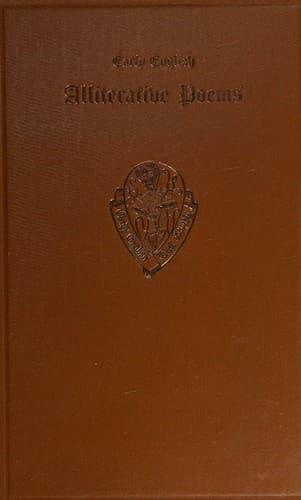
Early English Alliterative Poems: in the West-Midland Dialect of the Fourteenth Century
Religion
Early English Alliterative Poems: in the West-Midland Dialect of the Fourteenth Century
English poetry -- Middle English, 1100-1500
[Sidenote: All these are tokens of wickedness and vengeance.]
Alle þyse ar teches & tokenes to trow vpon ȝet,
& wittnesse of þat wykked werk & þe wrake aft{er},
Þat oure fader forferde for fylþe of þose ledes.
[Sidenote: God loves the pure in heart.]
Þe{n}ne vch wyȝe may wel wyt þat he þe wlonk louies, 1052
& if he louyes clene layk þat is oure lorde ryche,
[Sidenote: Strive to be clean.]
& to be couþe i{n} his co{ur}te þ{o}u coueytes þe{n}ne
To se þat semly i{n} sete & his swete face,
Clerrer cou{n}seyl, cou{n}sayl con I non,
bot þat þ{o}u clene worþe. 1056
[Sidenote: Jean de Meun tells how a lady is to be loved.]
For clopy{n}gnel i{n} þe compas of his clene rose,
Þer he expouneȝ a speche, to hy{m} þat spede wolde,
Of a lady to be loued, loke to hir sone,
[Sidenote: By doing what pleases her best.]
Of wich bery{n}g þat ho be, & wych ho best louyes, 1060
& be ryȝt such i{n} vch a borȝe of body & of dedes,
& folȝ þe fet of þat fere þat þ{o}u fre haldes.
& if þ{o}u wyrkkes on þis wyse, þaȝ ho wyk were,
Hir schal lyke þat layk þat lyknes hir tylle. 1064
If þ{o}u wyl dele drwrye wyth dryȝtyn þe{n}ne,
[Sidenote: Love thy Lord!]
& lelly louy þy lorde & his leef worþe.
[Sidenote: Conform to Christ, who is polished as a pearl.]
Þe{n}ne co{n}fo{ur}me þe to kryst, & þe clene make,
Þat eu{er} is polyced als playn as þe p{er}le seluen. 1068
For loke fro fyrst þat he lyȝt w{i}t{h}-i{n}ne þe lel mayden!
[Sidenote: By how comely a contrivance did he enter the womb of
the virgin!]
By how comly a kest he watȝ clos þere,
When venkkyst watȝ no v{er}gynyté, ne vyole{n}ce maked,
Bot much clener watȝ hir corse, god ky{n}ned þeri{n}ne; 1072
[Sidenote: In what purity did he part from her!]
& efte when he borne watȝ i{n} beþelen þe ryche,
I{n} wych puryté þay dep{ar}ted; þaȝ þay pou{er} were,
Watȝ neu{er} so blysful a bo{ur} as watȝ abos[55] þe{n}ne
[Sidenote: No abode was better than his.]
Ne no schroude ho{us} so schene as a schepon þare, 1076
Ne non so glad vnder god as ho þat grone schulde;
[Sidenote: The sorrow of childbirth was turned to joy.]
For þer watȝ seknesse al sou{n}de þat sarrest is halden,
& þer watȝ rose reflayr where rote hatȝ ben eu{er},
& þer watȝ solace & songe wher sorȝ hatȝ ay cryed; 1080
[Sidenote: [Fol. 72a.]]
[Sidenote: Angels solaced the virgin with organs and pipes.]
For au{n}gelles w{i}t{h} i{n}strumentes of organes & pypes,
& rial ry{n}gande rotes & þe reken fyþel,
& alle hende þat honestly moȝt an hert glade,
Aboutte my lady watȝ lent, quen ho delyu{er} were. 1084
[Headnote: CHRIST WAS EVER PURE.]
Public-domain text, read in full here on John Shaqi.
Reviews
Reviews
No reviews yet
Be the first to share your thoughts on this work.
Elsewhere in the archive
Join the Discussion
Join the discussion
Sign in to leave a comment or review.
Sign InorCreate an account