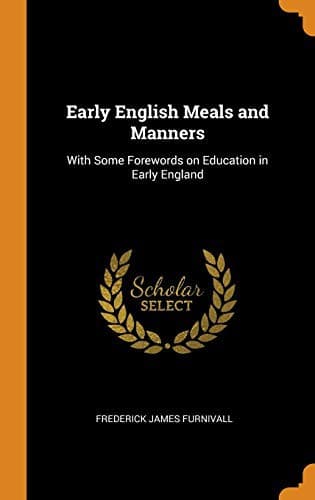
Education -- Early works to 1800; England -- Social life and customs -- Early works to 1800; Etiquette; Home economics -- Early works to 1800; Table
l. 85. Cheese. Whan stone pottes be broken, what is better to glew them
againe or make them fast, nothing like the Symunt made of Cheese; know
therfore it will quickly build a stone in a drie body, which is ful of
choler adust. And here in Englande be diuers kindes of Cheeses, as Suff.
Essex, Banburie .&c. according to their places & feeding of their
cattel, time of y^e yere, layre of their Kine, clenlinesse of their
Dayres, quantitie of their Butter; for the more Butter, the worse
Cheese. _Bullein_, fol. lxxxv.
l. 89. _Butter._ A. Borde, _Introduction_, makes the _Flemynge_ say,
Buttermouth Flemyng, men doth me call.
Butter is good meate, it doth relent the gall.
[[Note on l. 52 originally printed here: see Corrigenda.]]
l. 94. _Posset_ is hot Milk poured on Ale or Sack, having Sugar, grated
Bisket, Eggs, with other ingredients boiled in it, which goes all to a
Curd. R. Holme.
l. 94. _Poset_ ale is made with hote mylke and colde ale; it is a
temperate drynke. A. Borde, _Reg. G._ iij.
l. 105. Hot wines & sweet or confectioned with spices, or very strong
Ale or Beere, is not good at meales, for thereby the meat is rather
corrupted then digested, and they make _hot and stinking vapours_ to
ascend vp to the braines. Sir Jn. Harrington. _Pres. of Health_, 1624,
p. 23.
l. 109. Reboyle. ‘If any wynes be corrupted, _reboyled_, or unwholsome
for mannys body, then by the comtroller it to be shewed at the counting
bourde, so that by assent all suche pypes or vesselles defectife be
dampned and cast uppon the losses of the seyd chiefe Butler.’ _H. Ord._
p. 73.
l. 109. Lete, leek. ‘Purveyours of Wyne ... to ride and oversee the
places there as the Kinges wynes be lodged, that it be saufely kept from
peril of _leeking_ and breaking of vessels, or lacke of hoopinge or
other couperage, and all other crafte for the rackinge, coynynge,
rebatinge, and other salvations of wynes, &c.’ _H. Ord._ p. 74.
SWETE WYNES, p. 8, l. 118-20.[*]
[Footnote *: See _Maison Rustique_ or The Country Farme, p. 630-1,
as to the qualities of Sweet Wines.]
α. Generally:
Halliwell gives under _Piment_ the following list of wines from MS.
Rawlinson. C. 86.
_Malmasyes_, _Tires_, and _Rumneys_,
With _Caperikis_, Campletes[†], and _Osueys_,
_Vernuge_, _Cute_, and _Raspays_ also,
Whippet and Pyngmedo, that that ben lawyers therto;
And I will have also wyne de Ryne,
With new maid _Clarye_, that is good and fyne,
_Muscadell_, _Terantyne_, and _Bastard_,
With _Ypocras_ and _Pyment_ comyng afterwarde.
MS. Rawl. C. 86.
[Footnote †: See _Campolet_ in “The Boke of Keruyng.”]
And under _Malvesyne_ this:
Ye shall have Spayneche wyne and Gascoyne,
_Rose coloure_, whyt, _claret_, rampyon,
_Tyre_, _capryck_, and _malvesyne_,
Sak, _raspyce_, alycaunt, _rumney_,
_Greke_, _ipocrase_, new made _clary_,
Suche as ye never had.
Interlude of the Four Elements (no date).
Public-domain text, read in full here on John Shaqi.
Reviews
Reviews
No reviews yet
Be the first to share your thoughts on this work.
Elsewhere in the archive
Join the Discussion
Join the discussion
Sign in to leave a comment or review.
Sign InorCreate an account